Markets are not, for us, something you do on holiday. They're how the week works. Sunday morning is Issigeac; Tuesday is Beaumont; Thursday night is Issigeac again under the plane trees; Saturday is Villeréal; Sunday night is Monbazillac. Five markets within a twenty-minute drive of the estate, each with its own character, each with producers we've got to know by name. It's not a list of things tourists should see. It's how we buy dinner.
If you're staying with us, this is also — once you've done the big set-piece days to Sarlat and Marqueyssac — what the week actually looks like. Not because the markets are what we send you to, but because they're where we're going anyway, and where we'd tell any friend to go first. The producers are better than the restaurants. The food is fresher than anything you'll buy in town. The wine is cheaper by a third. And the morning feels like the one you came to France to have.
Six days, five markets, and — if the timing is right — one extremely good goat's-cheese burger.
I · Sunday morningIssigeac, six minutes away.
Our home market. Six minutes down the road from the estate, in a tight medieval village built in a spiral around a 14th-century gothic church. The weekly Sunday market wraps around the church, through the arcaded streets and out into the plane-tree squares, and it draws producers and antiquarians from a fifty-kilometre radius. It's the big one. Everyone comes.
The rhythm, roughly: park at the edge (the free lot on the Villeréal road, almost always space before ten), walk in through the south gate, follow the smell of the rotisserie chickens. The market fans out from the église Saint-Félicien in a rough spiral. Food stalls to the west, the antiques and brocante stalls under the plane trees to the north, the bio and organic corner behind the halle.
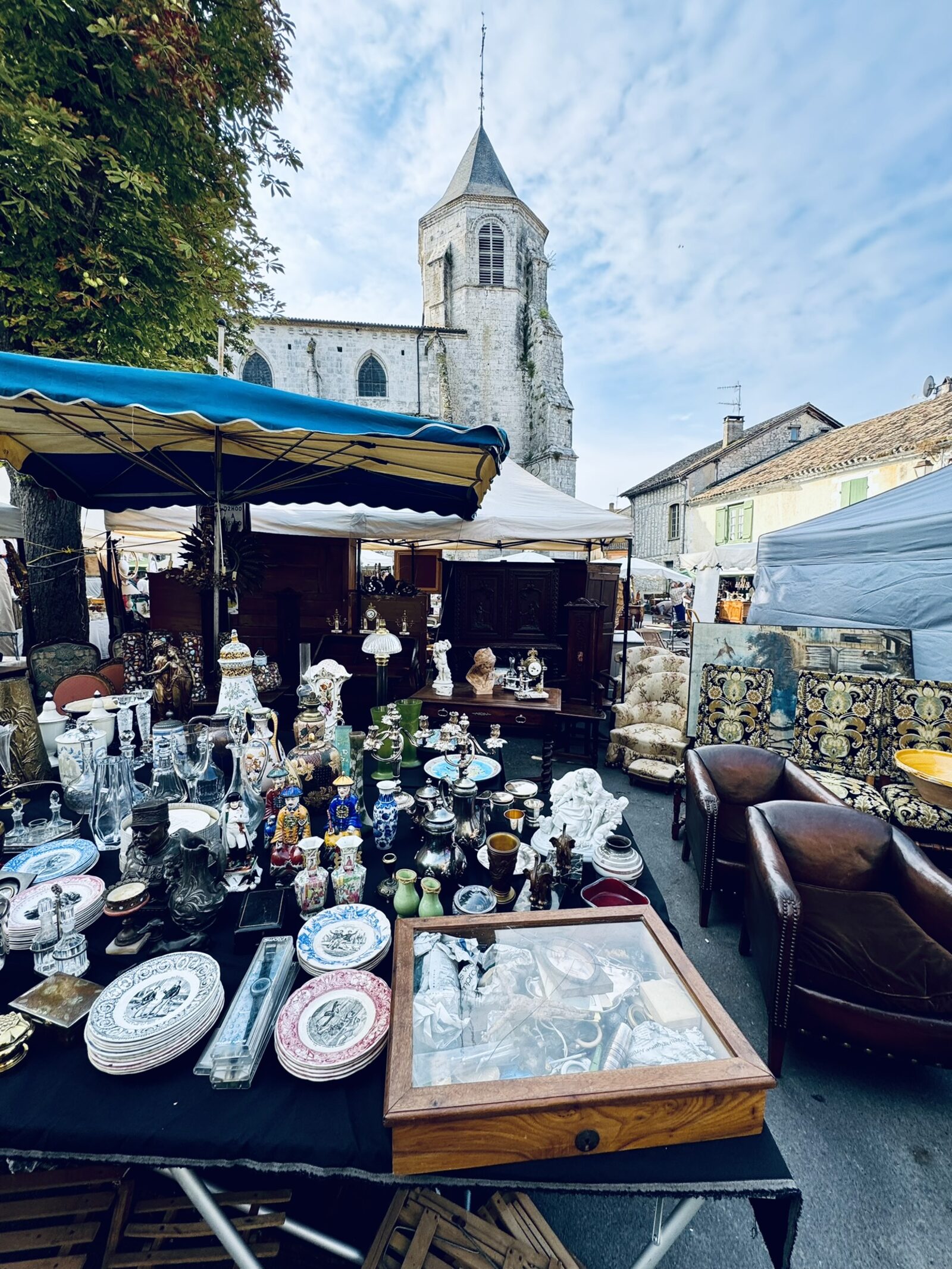
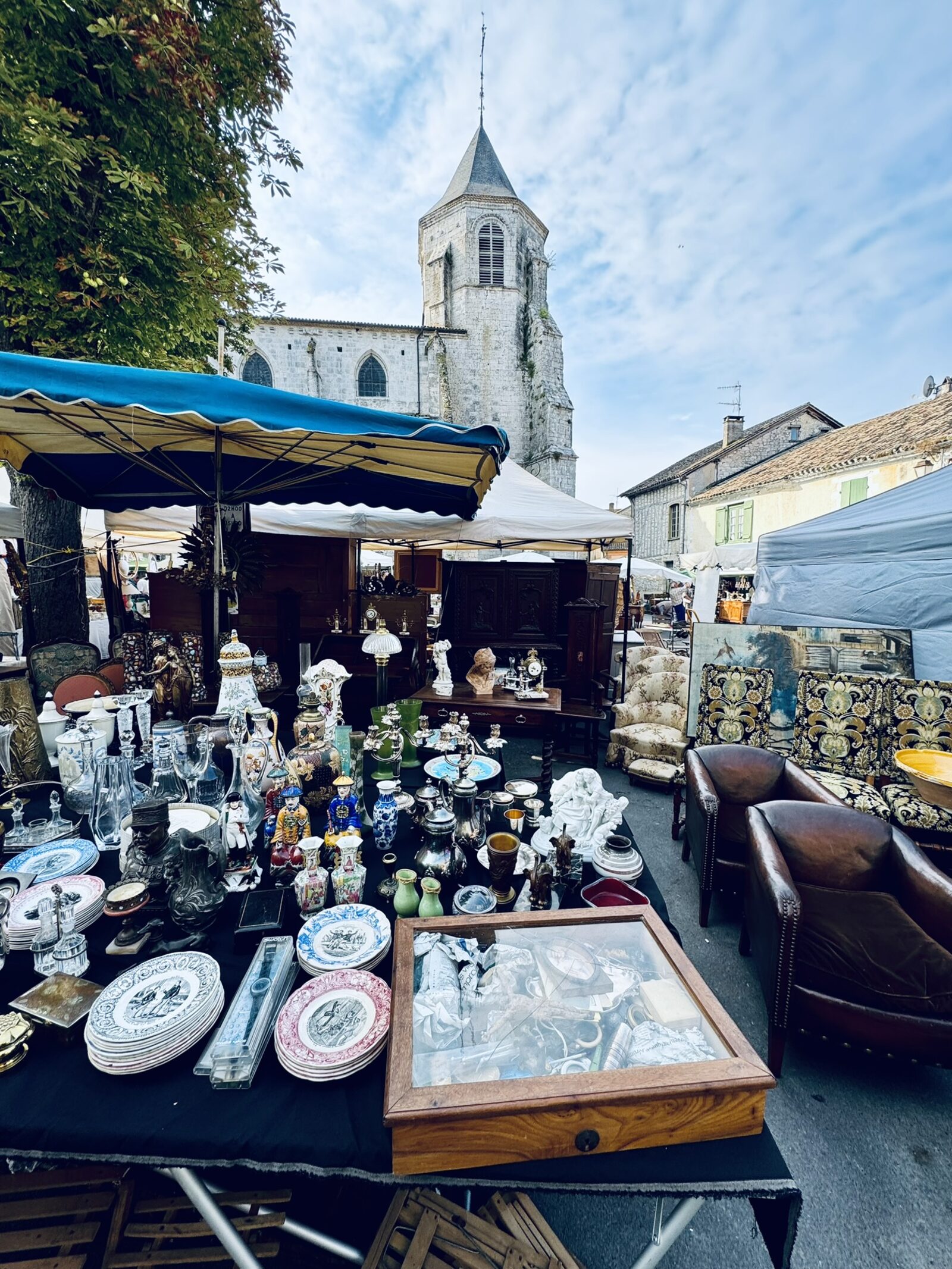
The antiques are serious — Issigeac is one of the better brocante towns in the southwest, and the Sunday stalls are the real thing. Napoleonic figurines, faience from Gien and Moustiers, silver tea services, leather club chairs, 19th-century prints. You're not going to pick up a Louis XV commode for fifty euros, but you might find a plate, a mirror, a lamp that the house was missing. We have, over five years, slowly furnished half the estate from these stalls.
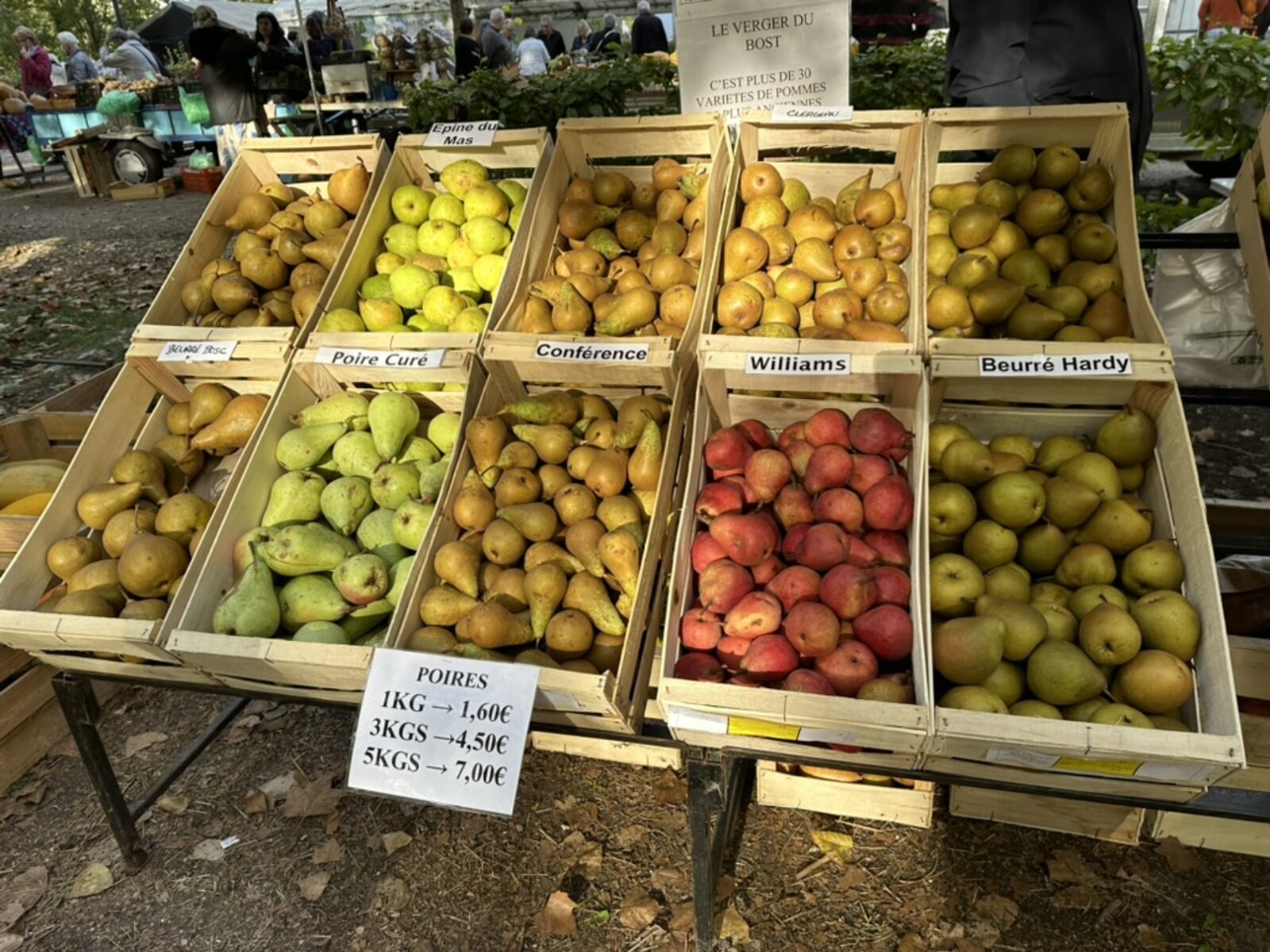
The food side is what we actually come for. Le Verger du Bost, the orchard north of Beaumont, brings thirty-plus apple varieties and twenty-plus pear varieties in wooden crates with hand-labelled signs — Épine du Mas, Poire Curé, Conférence, Williams, Beurré Hardy. One euro sixty a kilo. Seven euros for five kilos. We buy enough for the week, sometimes more. The bio stall does dried fruit and nuts from Lot-et-Garonne, coffee beans ground on the spot, local honey, jars of tapenade. The boulangers have queues from eight. The cheese van from the plateau has a goat's tomme that we buy in twos.
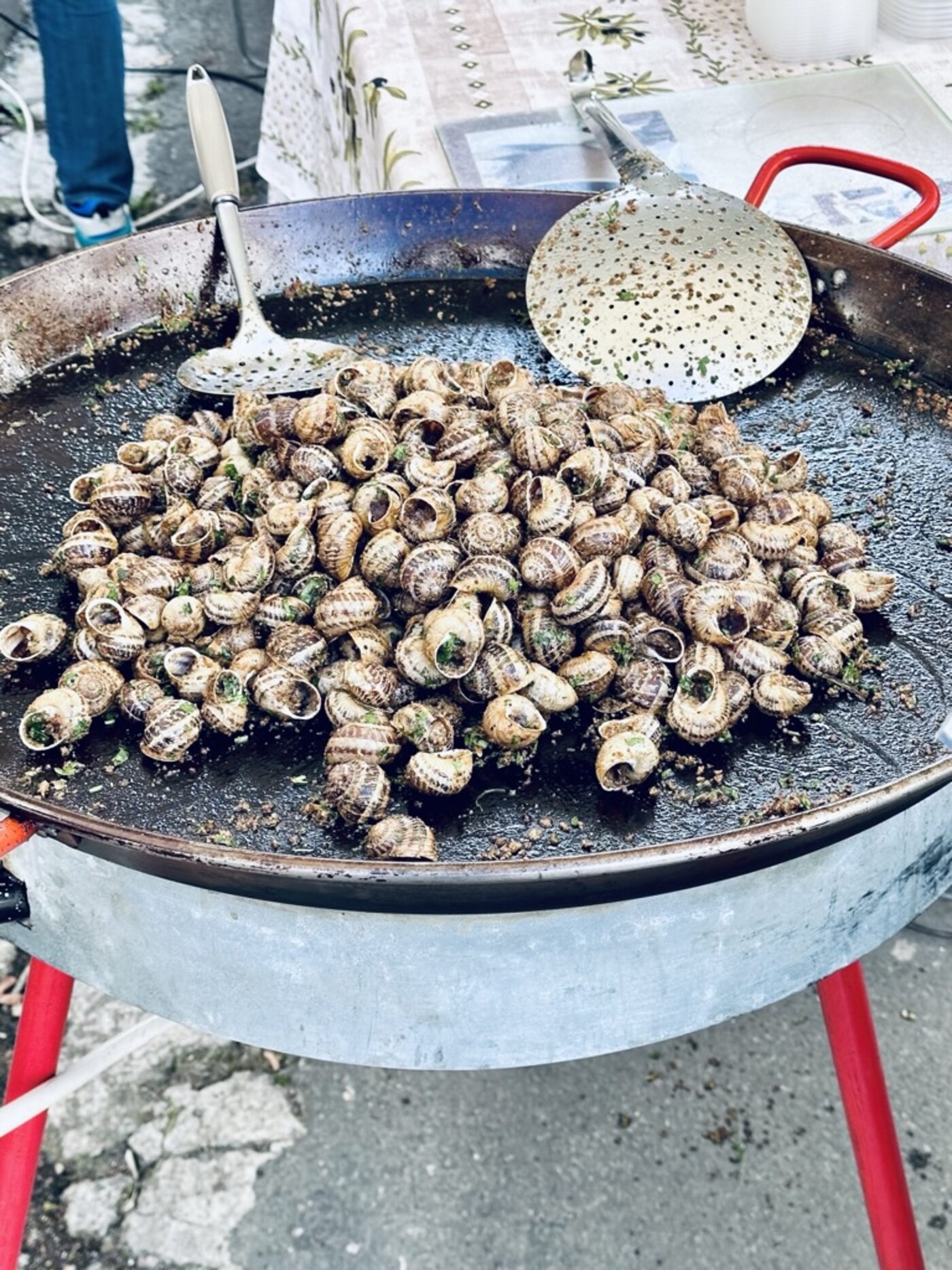
Then the escargots. Somewhere in the food quarter — near the chicken rotisserie, usually — a man cooks snails on a huge plancha: garlic, butter, parsley, a pan the size of a bicycle wheel, the smell getting to you from twenty metres away. Our daughters, who are Australian by birth and should on paper have no patience for snails, will eat them by the handful if they're really buttery and full of garlic and parsley, which these always are. They ask for them by name.
Our daughters, who are Australian by birth and should on paper have no patience for snails, will eat them by the handful if they're really buttery and full of garlic and parsley.
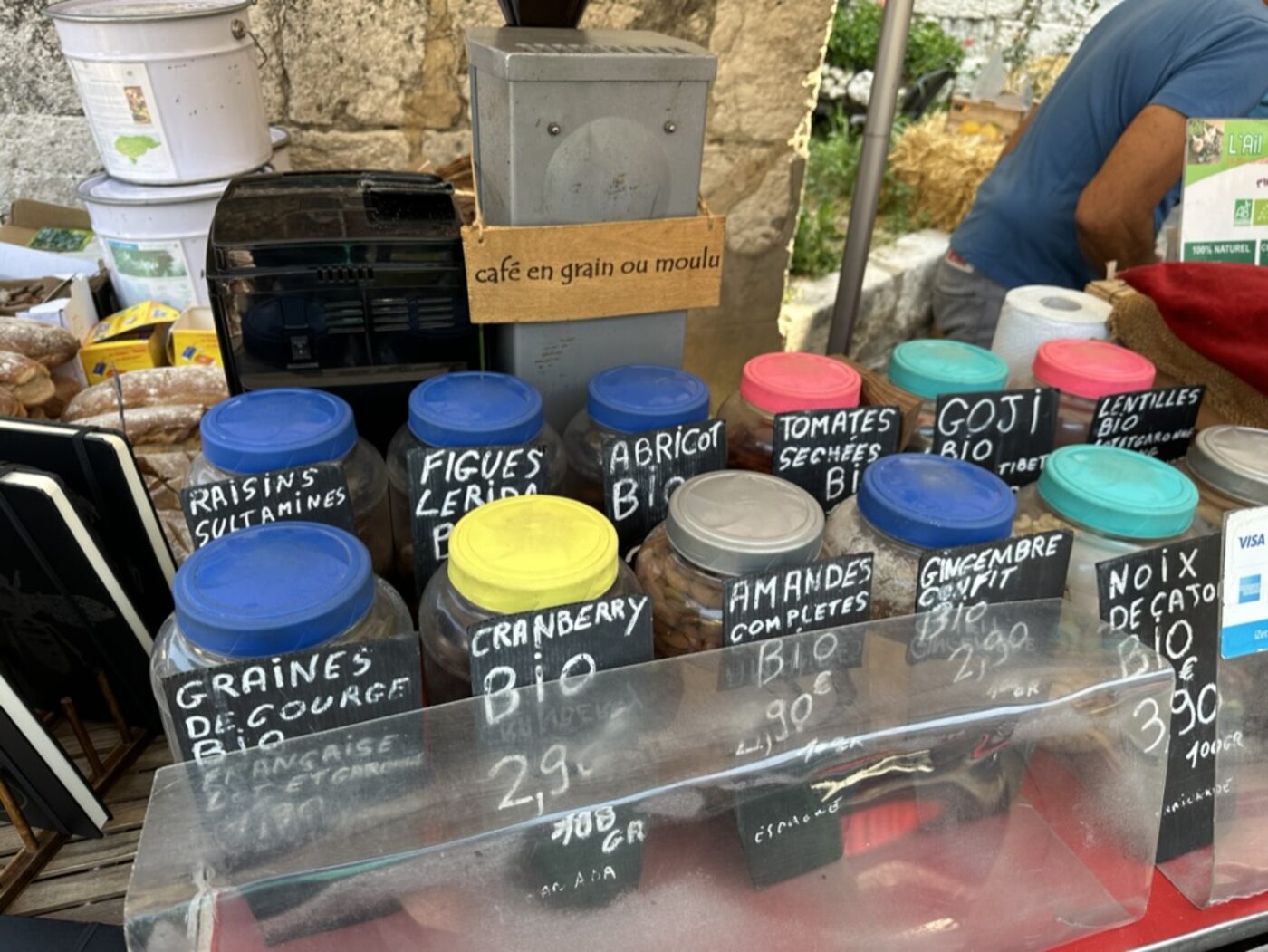
When we've bought what we need — usually around eleven, sometimes later — we drop the basket in the car and walk back in for coffee. There's only one place we go.
The coffee stopShabby Chic, Issigeac.
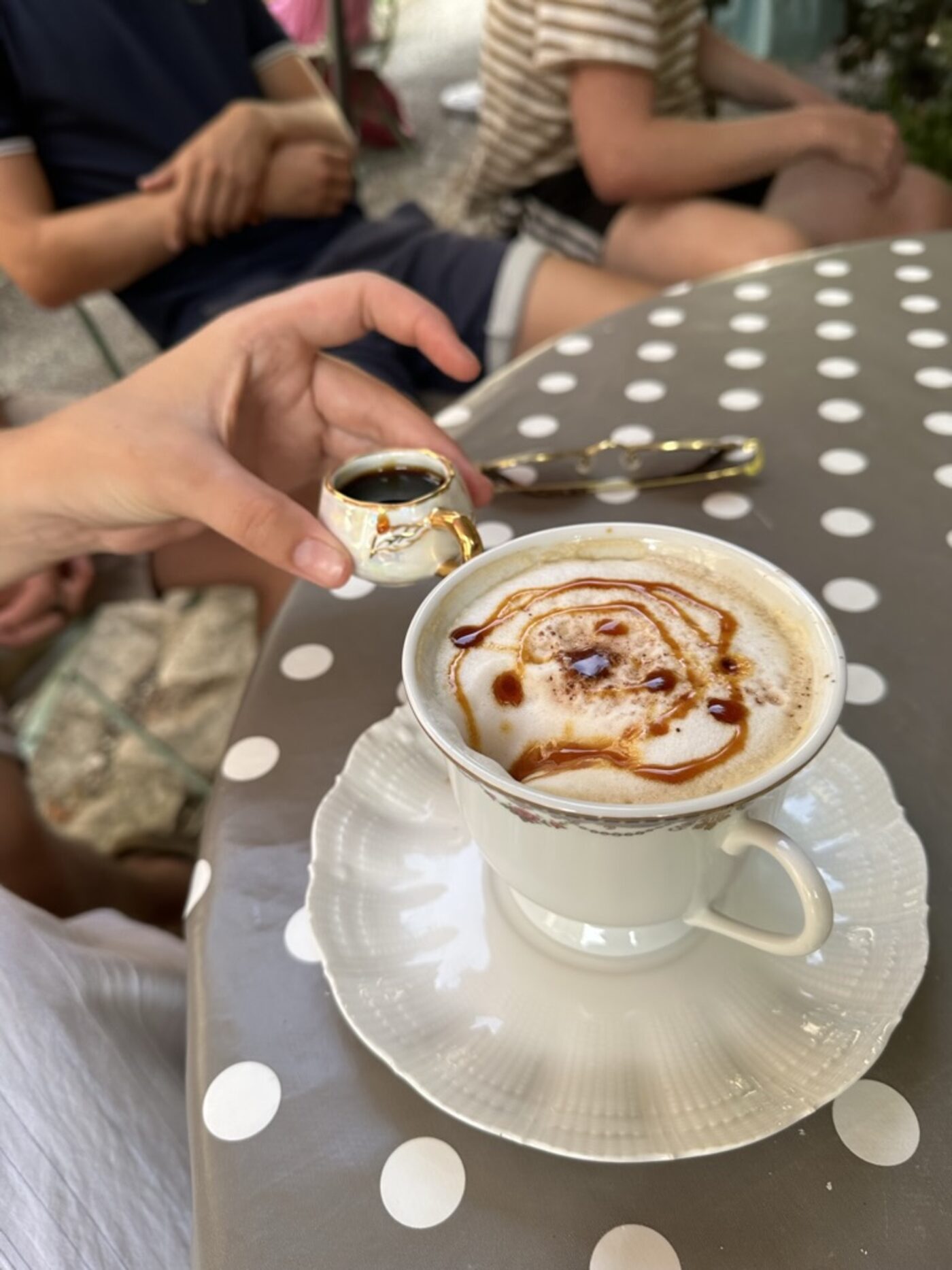
Tucked into a small lane off the main square is a blue-painted bifold-door café called Shabby Chic, and it is — to be blunt — the only coffee stop we never skip. The kind of place where the interior has more antique lamps than wall space, the tables are mismatched polka-dot enamel, the chandeliers are repurposed birdcages, and the coffees come with a drizzle of caramel on the foam and a tiny gold-rimmed porcelain cup of espresso alongside, for reasons that become clearer once you've had one.
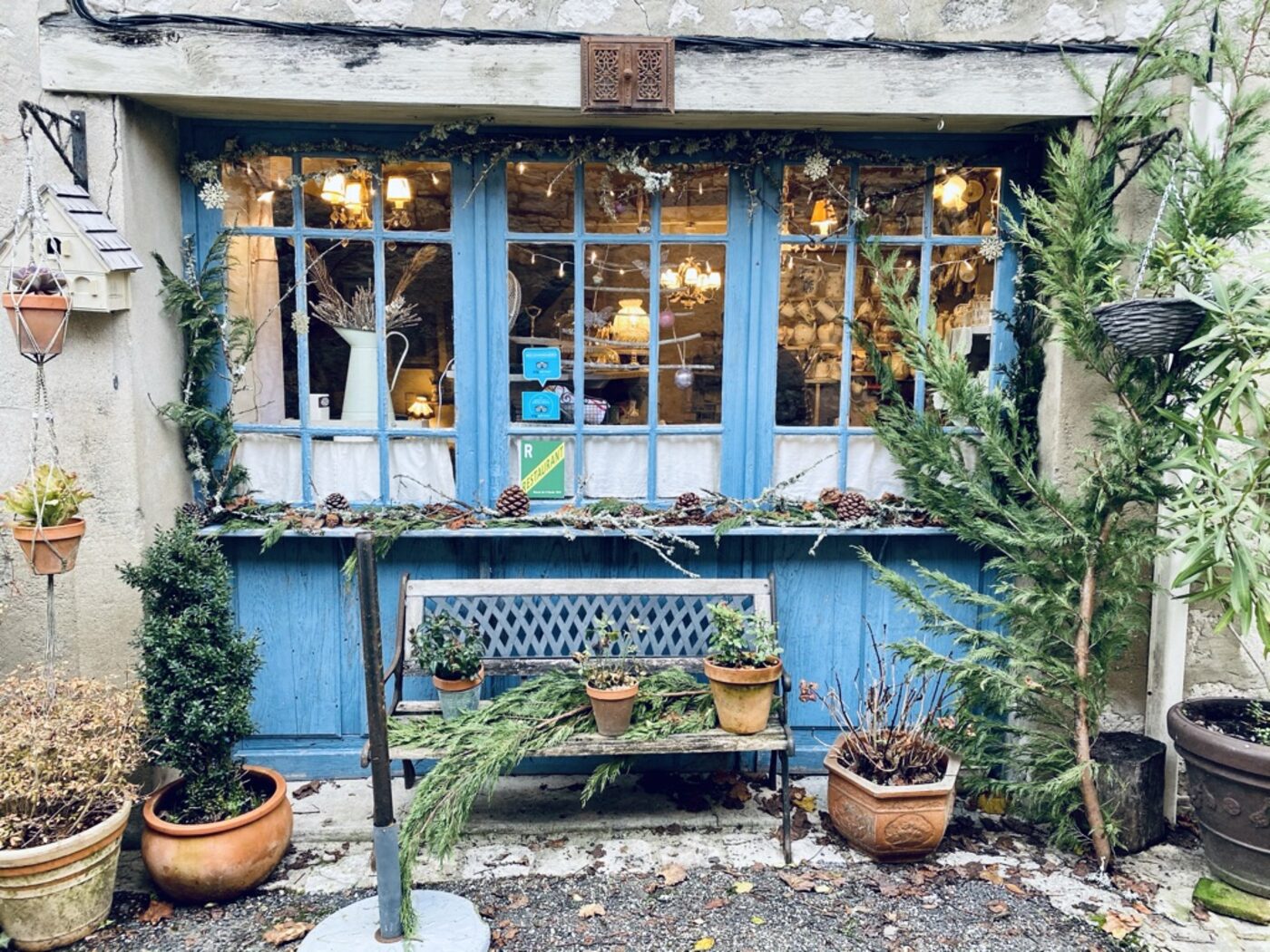
You will need to book. We learned this the first Sunday we turned up without a reservation, watched a queue form behind us, and ended up drinking excellent coffee standing on the cobbles. It's small, it's popular, and on a Sunday in July it's full by nine. Worth the forethought.
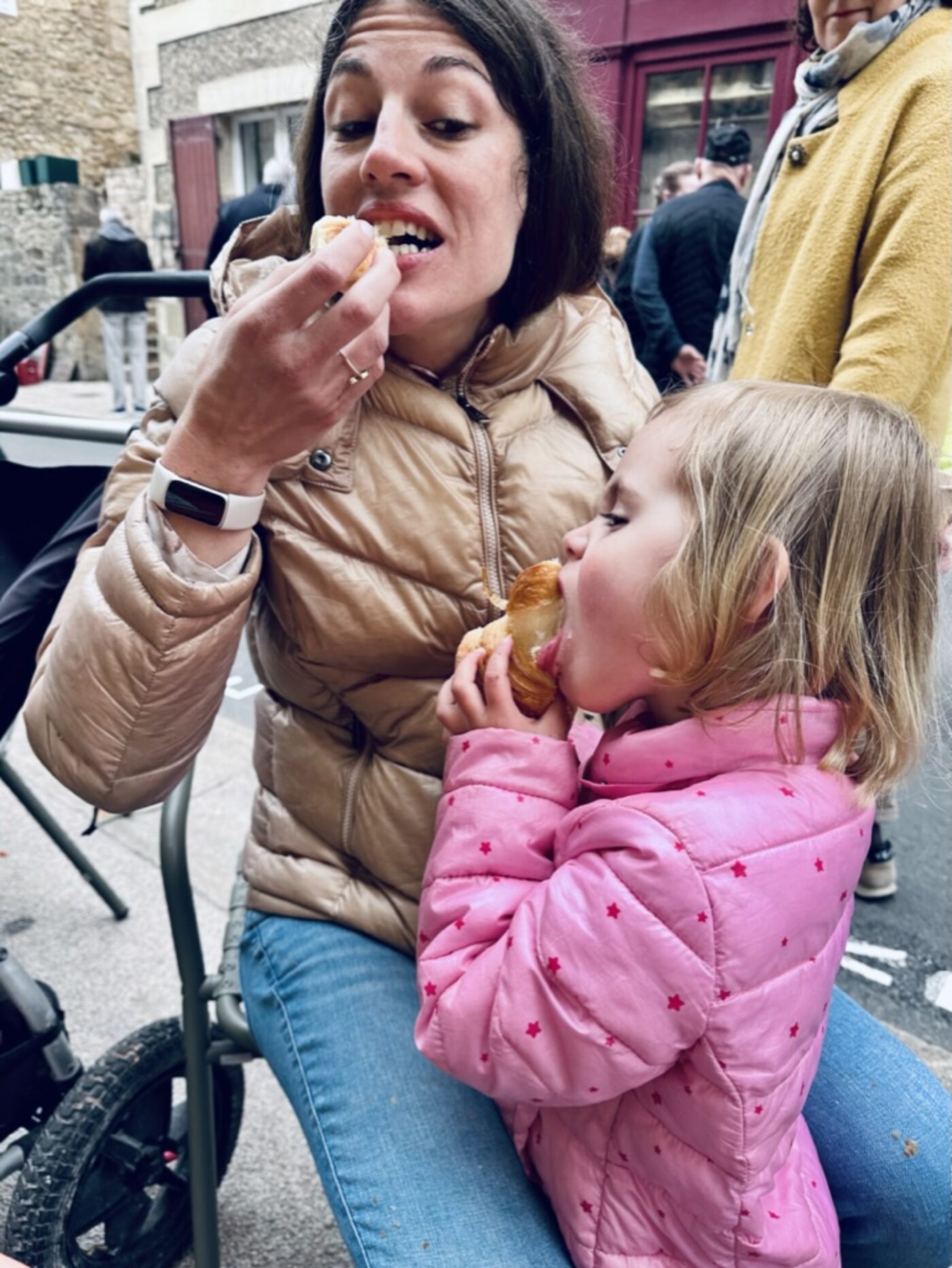
By noon, the market is folding up and we're heading home with the week's food, the week's flowers, sometimes a lamp, usually a plate, and the conviction that we live in the right part of France. Lunch is almost assembled before we walk through the gate.
II · Tuesday morningBeaumont-du-Périgord, under the halle.
Fifteen minutes northeast of the estate sits Beaumont-du-Périgord — a fortified bastide town founded by the English in 1272 as a strategic outpost during the Hundred Years' War, which is a long way of saying the architecture is spectacular. Beaumont is one of the bigger bastides, and like most of the bigger ones it runs two weekly markets: a smaller, more local one on Tuesday morning, and a bigger one on Saturday morning. We go Tuesday. Saturday we're at Villeréal.
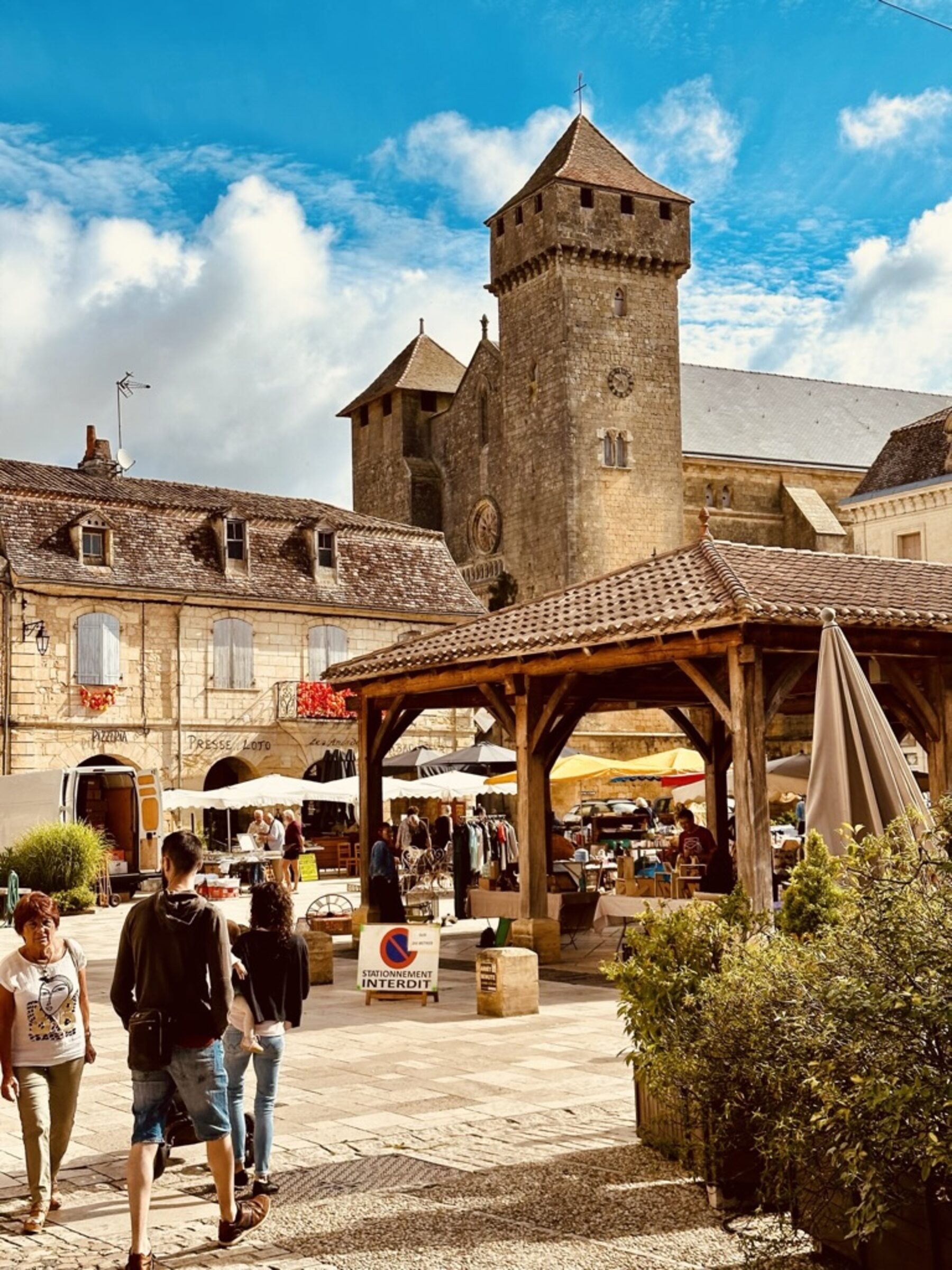
The Tuesday Beaumont market is smaller than Issigeac's Sunday but it's excellent, and the setting is — honestly — one of the most beautiful market backdrops in France. The stalls cluster under the halle and spill out into the square, framed by the arcaded stone houses on three sides and the twin-towered fortified church of Saint-Laurent on the fourth. The church was built to double as a refuge in wartime, which is why it has battlements. The morning light on the stone is something you stop for.
What you'd come for: the cheeses (a particularly good Rocamadour goat from a producer who only does Tuesdays), seasonal vegetables from three or four small producers rather than the big growers you get on Sundays, a baker who brings sourdough that disappears by ten. It's a working-locals market more than a tourist one. Which is precisely the recommendation.
If you come, stay on through lunch — the square has two or three terrace restaurants that do a workmanlike menu du jour at proper French prices. This isn't Sarlat; you won't be paying twenty-five euros for a croque-monsieur. A full lunch with wine for two should come in under fifty.
III · Thursday nightIssigeac, by the stream.
Summer only, and the best thing about summer. From roughly the end of June through the end of August, Issigeac runs a Marché Gourmand Nocturne on Thursday evenings — a night market that is technically a market but functionally a village dinner. You arrive around seven, buy plates from whichever producer stalls catch you, and carry them to the long trestle tables that have been set up under the plane trees along the little stream that runs through the town.
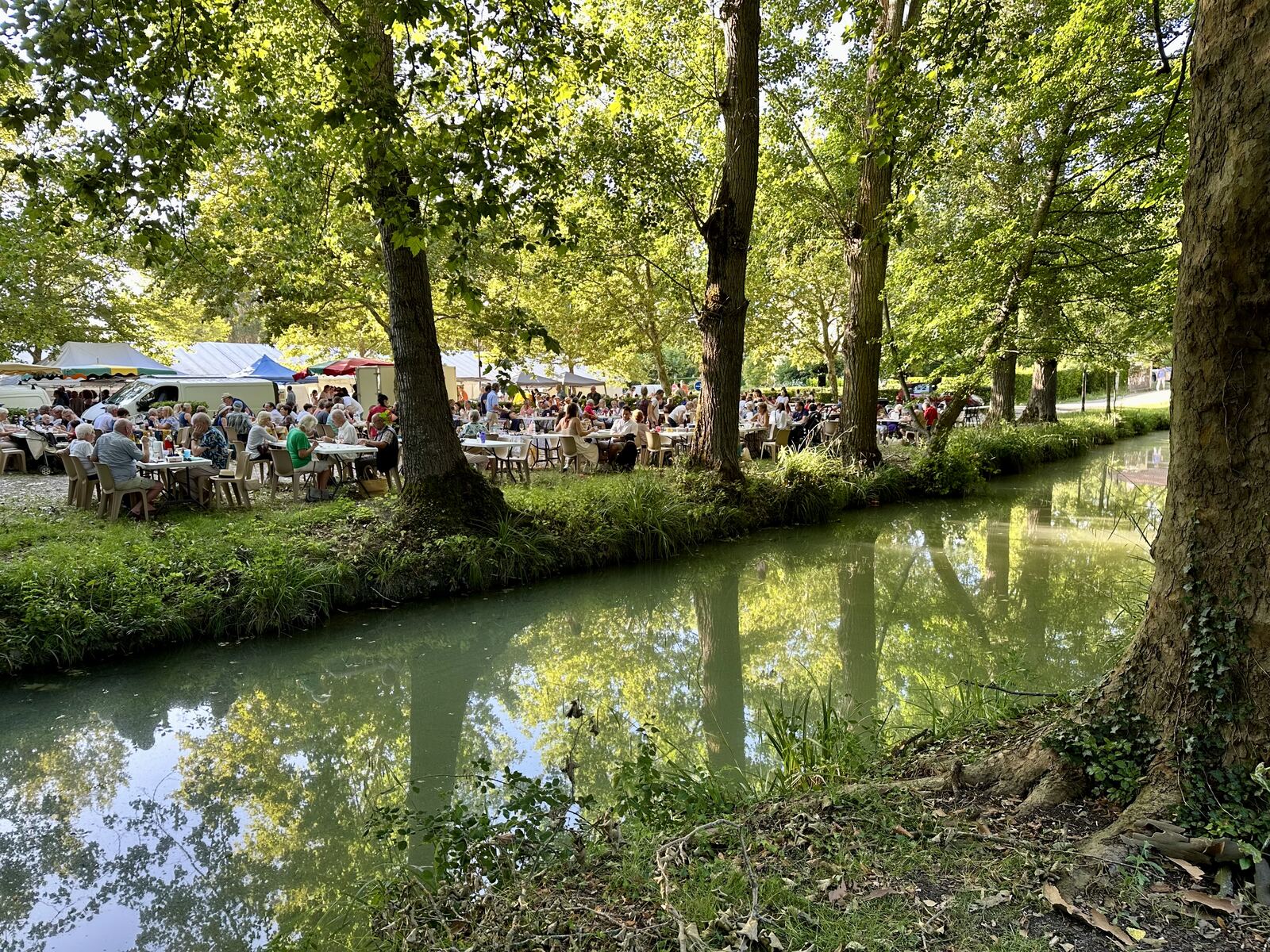
The stalls are local producers cooking: a butcher grilling duck hearts and magret, a crêperie doing galettes, a small oyster-bar from the Atlantic coast shucking on the spot, one stall doing wood-fired pizza, another doing Thai, another doing Moroccan, and — our favourite — a husband-and-wife operation whose contribution to the week is a burger with grilled goat's cheese, fig chutney, and a pile of hand-cut chips. With a local craft beer from the brewery at Lanquais or a glass of Bergerac rouge, it is the best eight euros you will spend in France.
A burger with grilled goat's cheese, fig chutney, and a pile of hand-cut chips. With a local craft beer, it is the best eight euros you will spend in France.
What to understand about Thursday night: it is not a restaurant with table service. You queue at the stalls, pay at the stalls, carry your plate to whichever free chair you find at the long tables, and eat alongside strangers who turn out, by the end of dinner, to be neighbours. Kids run in packs. Dogs sleep under benches. Nobody is in a hurry. By ten, people are still arriving. Music usually starts around nine, occasionally a local band, sometimes just someone's speaker on a folding table.
We go every Thursday from mid-July through August. So do half of Issigeac. If you're staying with us during those months, it's the one evening trip we'd put ahead of anything else — above even Marqueyssac by candlelight, because Thursday-night Issigeac happens every week and you can go four times across a fortnight's stay without it getting old.
IV · Saturday morningVilleréal, under the bunting.
Twenty-five minutes south, technically over the border into the Lot-et-Garonne department, is Villeréal — another 13th-century bastide, another spectacular square, and on Saturdays one of the biggest weekly markets in the southwest. Bigger than Issigeac's Sunday. Possibly the prettiest of the five markets, though we might be outvoted on that by anyone who loves Issigeac.
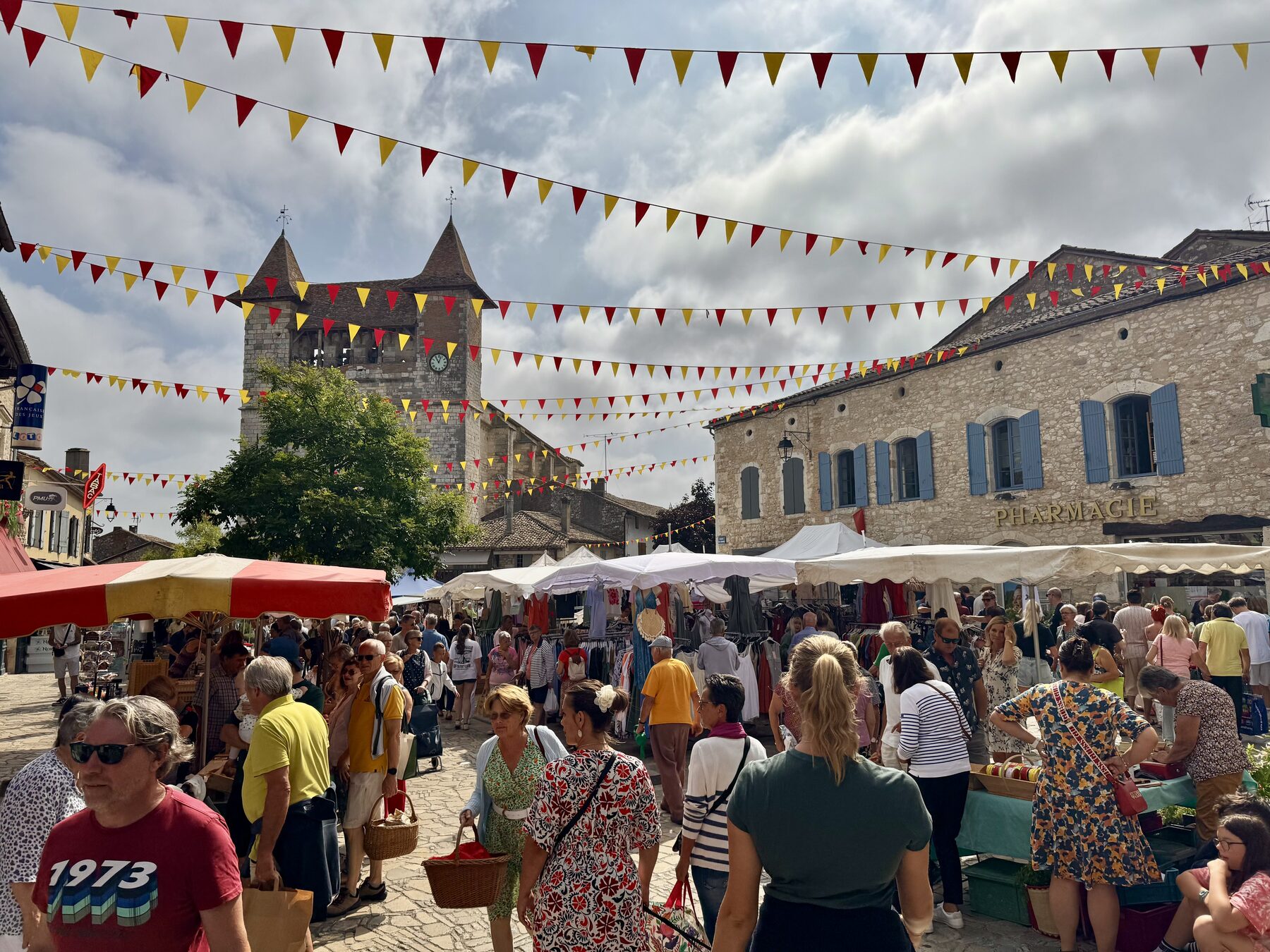
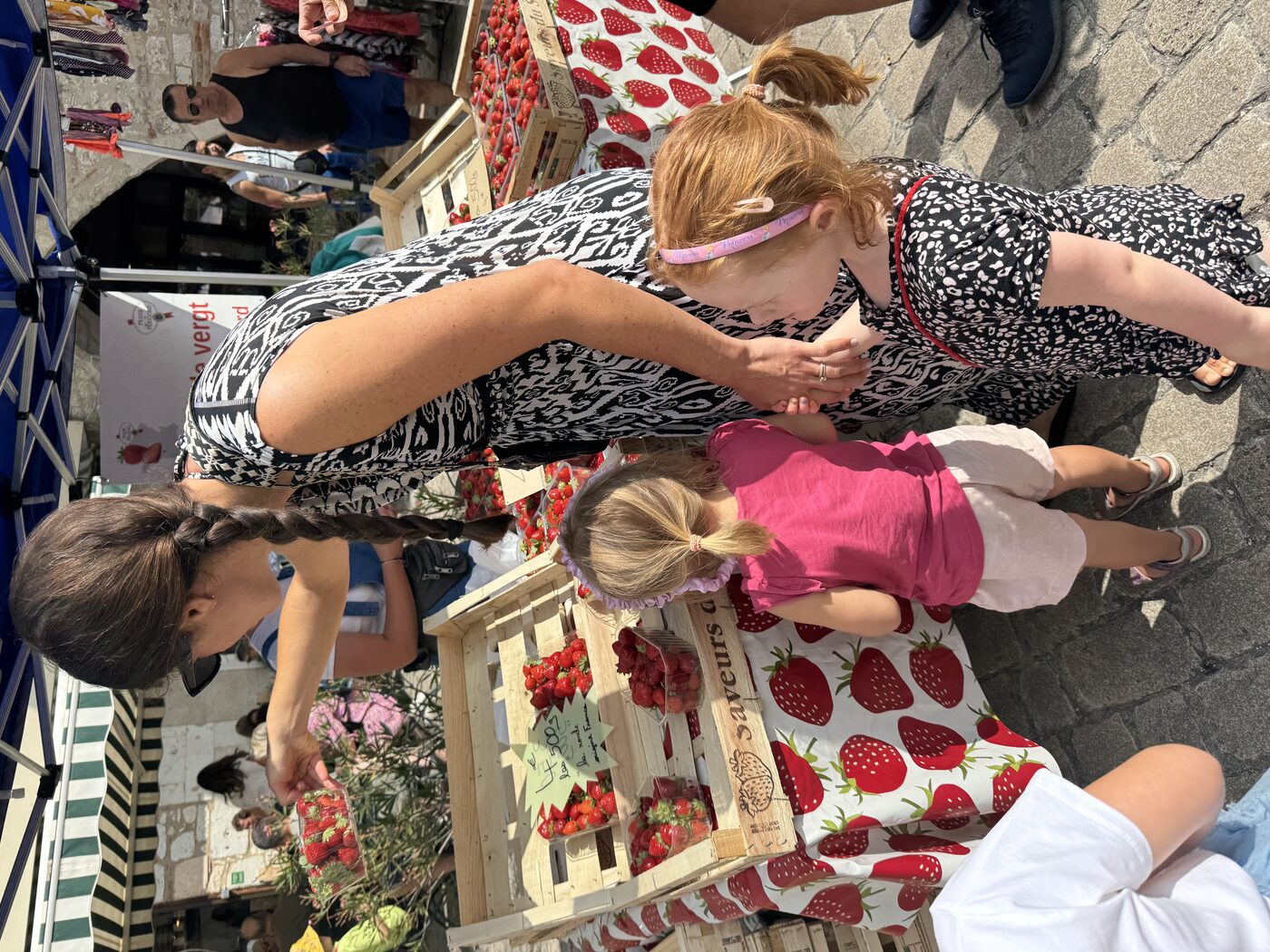
Villeréal is the market for variety. Issigeac gives you the serious food-and-antiques combination; Beaumont gives you the locals' market under a halle; Villeréal gives you the full Saturday-morning carnival — food on the south side, clothes and household goods stretching down the east, flowers and plants along the halle, one of the best cheese selections we've found anywhere in the region, two rotisseries, a live oyster stall, the Fraises du Périgord IGP stand (the protected-appellation Périgord strawberry, worth the trip on its own in late spring), and always a musician or two wandering through. The red-and-yellow bunting (the Occitan colours) is up most of the summer.
The town itself is worth an hour after the shopping. The square is one of the most intact bastide squares in France, the church tower is wonderfully lopsided (one tower finished, one never built, which somehow makes it better), and there's a small rectangular plan laid out in straight streets radiating from the square — classic bastide geometry from when these towns were new in the 13th century.
Saturday also means lunch on a terrace. Several restaurants face the square. The one with the yellow awning on the west side is our default — reliable, unremarkable in the best sense, reasonable.
V · Sunday nightMonbazillac, producer stalls at dusk.
The closing bracket of the week, and the smallest market. Every Sunday evening in summer, producers from the Monbazillac appellation set up a small night market in the village above the chateau — twenty minutes south of the estate, with the chateau and the Bergerac vineyards falling away below. Half-a-dozen stalls, not thirty. Wine by the glass from the producers themselves, cheese from the plateau, a pâté stand, a vegetable producer, and — for reasons that make more sense on a summer evening than in any article — a stall doing a pork burger with sauce gribiche and a pile of fries that rivals the Thursday goat's-cheese one, not quite as good but a close second.
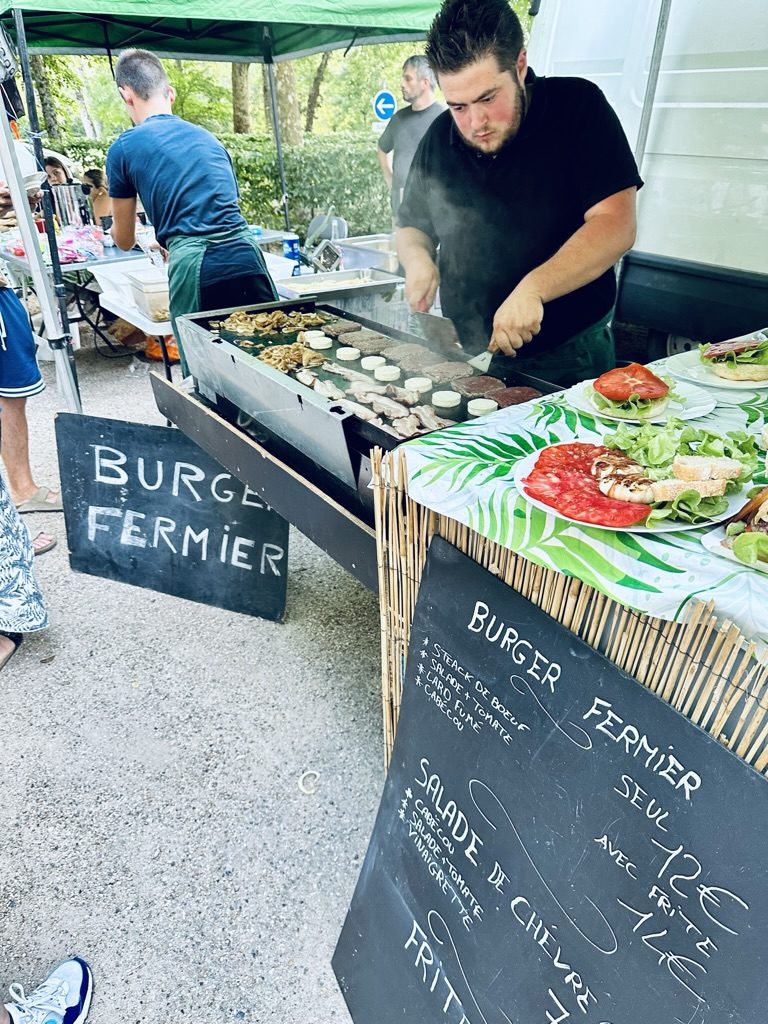
The draft beer is local and cold. The wine is sold, in the main, by the producers themselves — which means you can try the Monbazillac from six different houses in one evening, with the people who pressed it telling you about the year. If you're serious about Bergerac wines and want a short-cut to understanding the Monbazillac sub-appellation, there is no faster way in France.
It's also, at sunset, genuinely beautiful: the stalls face west, the vineyards step down toward the Dordogne river below, and by eight the whole scene is in golden light. Bring a jumper — it cools fast once the sun goes behind the chateau.
If you want to plan a week around the market rhythm: Sunday is Issigeac and lunch on the terrace at home, Tuesday is Beaumont in the morning, Wednesday is the Marqueyssac day east, Thursday is the quiet roads to Périgueux north (with the Saint-Astier morning market on the way), Thursday evening loops back to the marché nocturne at Issigeac, Saturday is Villeréal in the morning and Bergerac wine visits in the afternoon, Sunday evening closes the week at Monbazillac. That's a full week, no repeats, almost no driving on the busy roads.