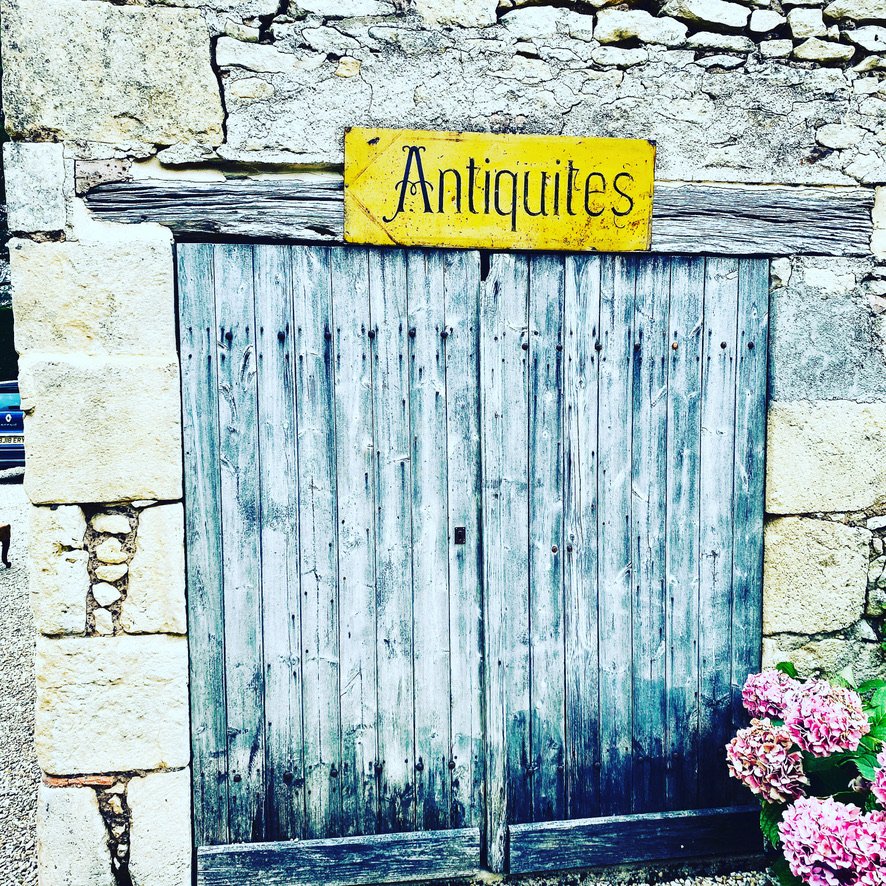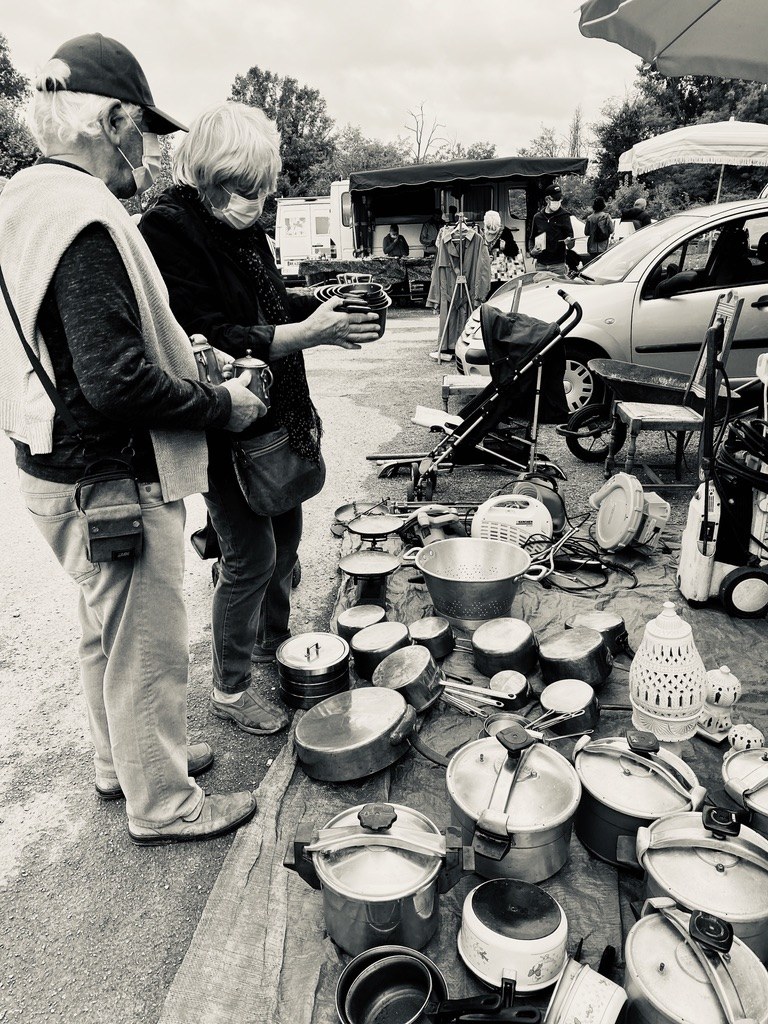
Pat is my cousin. Geoff is her partner. Between them they've been buying old French furniture and shipping it back to England for longer than either of them would probably want me to specify in print, and at some point along the way they bought a small property in a hamlet called Le Bost, in the village of Douchapt, an hour's drive north of the estate. They live there for six months of every year. The other six they're in England, where the trade is.
What follows is what they taught us, mostly without meaning to, mostly over six or seven years of being trailed around by an Australian cousin who turned up at fairs with a notebook and too many questions. Some of it can be found in a guidebook. Most of it can't.
I · The geographyThe Périgord Vert.
Most English-language travel writing about the Dordogne fixates on the south — the Périgord Pourpre around Bergerac and Sarlat, the Périgord Noir around the Vézère caves, the famous bastide villages and the famous wine. We sit in the Pourpre, six minutes from the Sunday market at Issigeac, twenty minutes from Monbazillac. That part of the region is well-mapped, well-photographed, and increasingly well-priced.
Pat and Geoff are an hour north of us, in the Périgord Vert — the upper Dordogne, the green Périgord, the part nobody writes about in English. Douchapt sits between Ribérac and the Charente border, in a landscape of small valleys and oak woods and depopulated stone villages where the brocante economy has the texture of a working trade rather than a tourist amenity. Brantôme is twenty minutes east of them. Périgueux is half an hour south. The fairs they hunt run in a wide arc — northern Dordogne, the Charente, the Limousin foothills, occasionally as far as the Lot-et-Garonne. The geography is bigger and quieter than the southern Dordogne, and the inventory is meaningfully better.
Their Instagram is @lebostbrocante — *the brocante of the place called Le Bost*. The handle gives away how they think about themselves. They are, by their own choice of public name, a French operation that happens to sell mostly into the UK trade.
Walk twice.
The first thing Pat taught me was that you walk a fair twice before you buy anything. The first time fast — eyes up, take in the scope of what's there, register where the dealers are positioned and what kind of stock each one has brought. The second time slow, with your shopping list and your tape measure, returning to the three or four stalls that flagged something on the first pass.
This sounds obvious. It is not what most people do. Most people walk a fair once, slowly, get distracted by the first interesting thing they see at table three, spend forty minutes in front of it weighing it up, and miss the better version of it that's sitting at table forty-seven. Geoff puts it like this: "the first time you're scouting, the second time you're shopping. Don't try to do both at once."
The corollary is that you have to be willing to walk past beautiful things on the first pass without stopping. That's harder than it sounds. The discipline of not buying on first sight is the single most expensive lesson in the trade — *you save serious money over a lifetime by not buying the first lovely thing you see.* The second-pass version is often cheaper, often older, and often closer to what you actually need.
III · The second lessonThe dealer's face.
The second thing — and this is harder to articulate without sounding mystical — is that you learn to read the dealer's face. Pat will pause at a stall, pick up a small object, turn it over, and look at the seller. Sometimes the seller's expression tells her the price will be flexible. Sometimes it tells her the seller has decided this object is going home in the van rather than for less than the price on the tag. The information is in the face, not the tag.
What you're reading is whether the dealer wants to *trade* or wants to *display*. A dealer who is end-of-day, has had a slow morning, has visible weariness around the eyes, who has overstocked their stall — that dealer wants to trade. A dealer who has perfectly arranged stock, a freshly poured coffee, a cheerful demeanour at 9am — that dealer wants to display. The first dealer will negotiate. The second won't. The price on the tag is the same. The reality behind the tag is completely different.
This is the part of the trade that genuinely cannot be put in a guidebook. You learn it by being there with someone who already knows. Which is, in the end, what Pat and Geoff have done for us.
Provenance is a conversation.
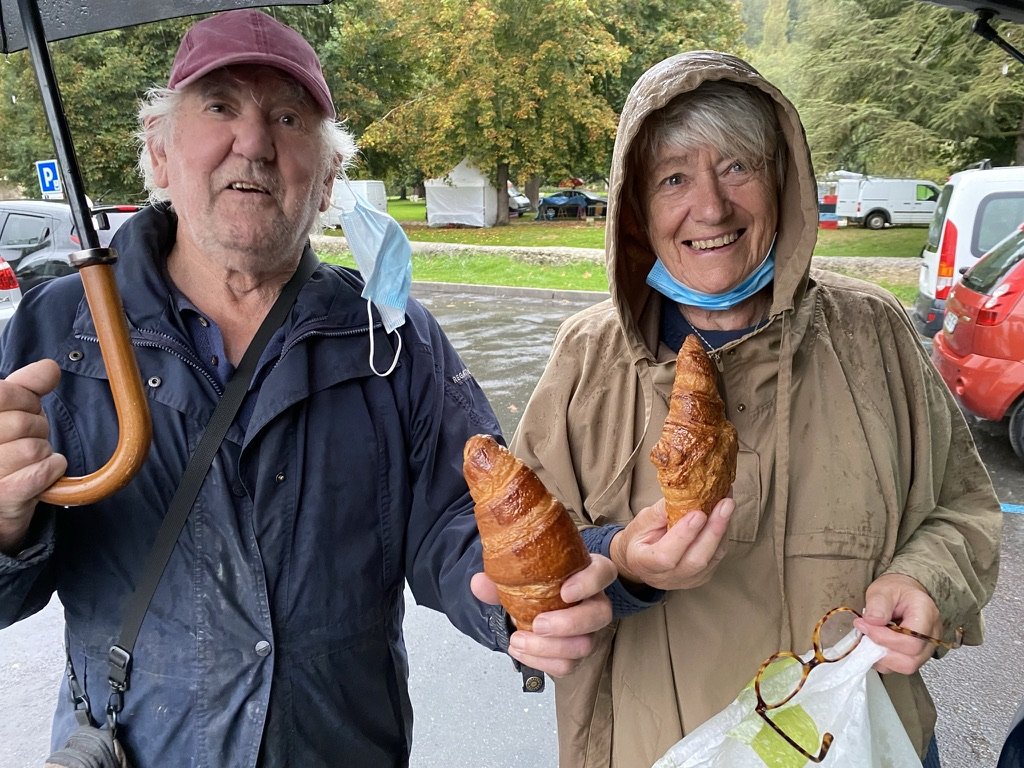
The third thing is that provenance — *where did this come from, who made it, when, in what tradition* — is something you ask about, not something you read on a card. The card, if it's there at all, will tell you what the dealer wants you to think. The conversation will tell you what the dealer actually knows.
A serious dealer in the Périgord can tell you which workshop region a 19th-century chair came from by the joinery, the wood, the nail pattern under the seat. They can tell you whether a cabinet is locally provincial or imported from Paris by the proportions and the foot detail. They will not volunteer this information, because most buyers don't ask and most buyers don't care. But if you ask in a way that signals you're not trying to score points off them — *"can you tell me where this is from? what's the wood?"* — the conversation that follows will be more useful than any number of catalogue entries.
Geoff is particularly good at this. He's the patient one, the one who'll spend twenty minutes with a dealer establishing whether a piece is what it claims to be before either of them mentions price. The price conversation is faster and friendlier *because* the provenance conversation has already happened. Cause and effect.
V · The fourth lessonThe boring stuff matters.
The fourth thing — and this is properly unromantic — is that the boring objects are often the best buys. Cookware. Old enamel. Glass jars. Wooden fruit crates. Linen sheets. Plain provincial chairs. Things nobody is hunting for, which means there's no premium on them, which means the prices are honest. A cast-iron Le Creuset from the 1960s for fifteen euros is a better buy than a fashionably-aged Empire mirror at two hundred. The cast iron will be in your kitchen in twenty years. The mirror will be on a wall.
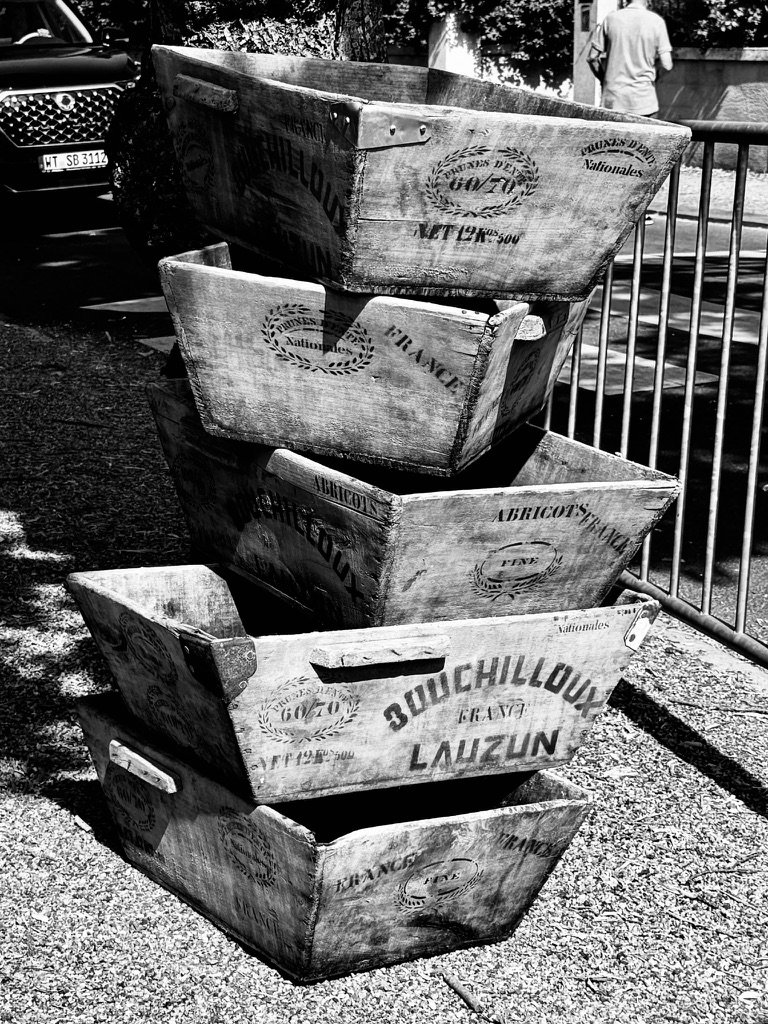
Pat collects French wooden fruit crates — *cagettes* — with their original stencil printing. The ones that say *PRUNEAUX D'ENTE 60/70 · NET 12K500* and *ABRICOTS FRANCE* and the names of the villages they were packed in. They cost three or four euros each and they are, properly, the most beautiful objects we own. Functional, weathered, locally specific, irreplaceable. The kind of object the trade ignores and the trade is wrong about.
Cash, and walking away.
Two practical things that operate together.
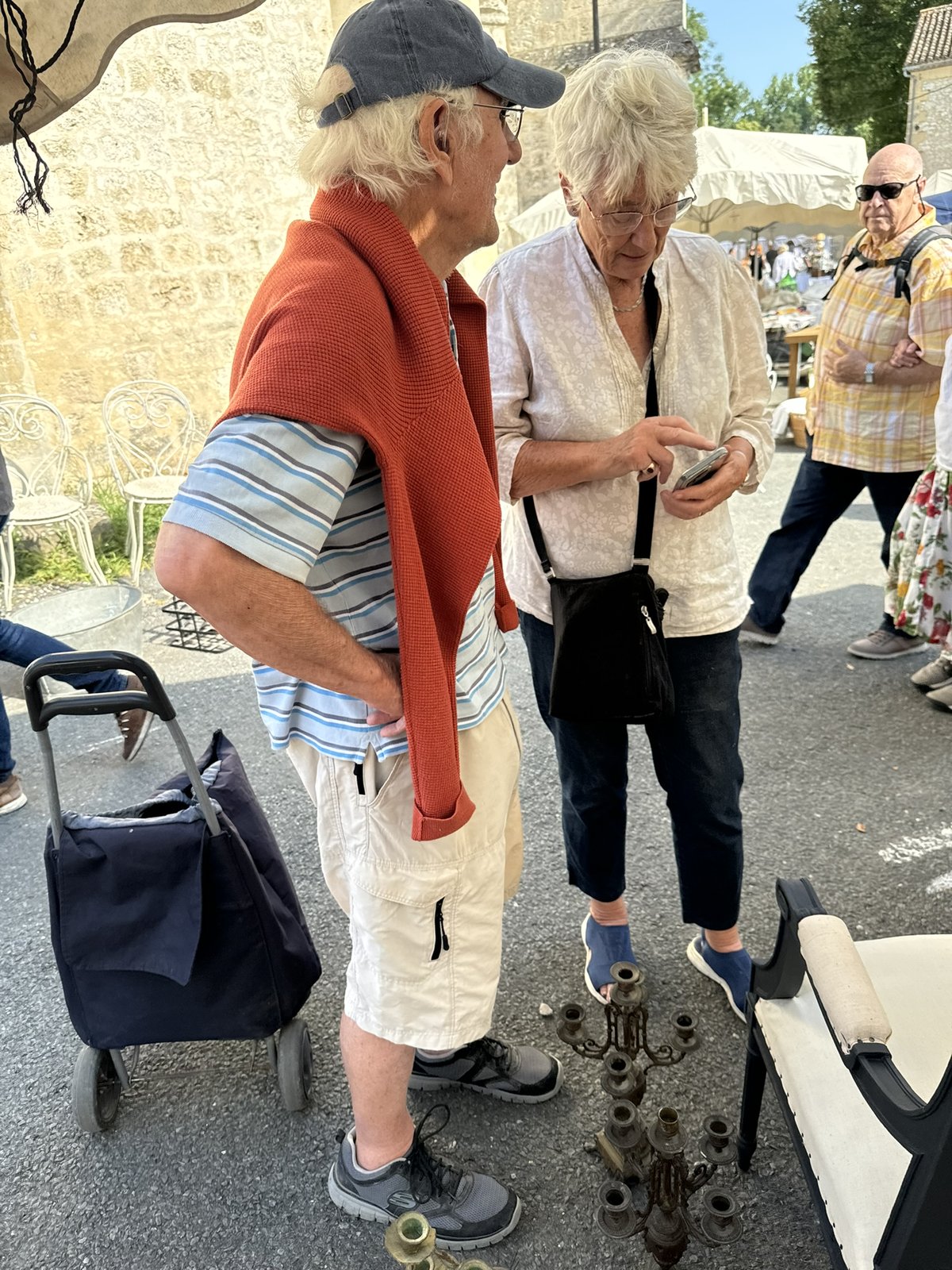
Cash changes the price. Carry several hundred euros in notes if you're serious about hunting. At a vide-grenier or a smaller brocante, a cash price is often meaningfully lower than a card price. This isn't tax evasion on your part — the pricing just genuinely flexes when the payment is cash, partly because dealers prefer not to wait for card settlement, partly because cash is the trade's traditional medium and the muscle memory is still there.
Walking away is part of the negotiation. The polite French phrase is *"je vais réfléchir"* — *I'm going to think about it.* You can also just say *"merci, je vais voir ailleurs"* — *thanks, I'll look elsewhere.* Either of these, said pleasantly, gives the dealer a moment to decide whether they want to come down. Maybe a third of the time, they do. *"Attendez —"* they call after you. *Wait. Tell me what you wanted to pay.* That's the moment.
Pat is properly good at this. The walking-away looks unforced, almost regretful. It's not a tactic — it's that she's genuinely already decided the object isn't worth the asking price and is moving on. Which is exactly why it works. The dealer reads her *also*, and what they read is a buyer who isn't bluffing.
Cash changes the price. Walking away is part of the negotiation.VII · The fairs we go to with them
Issigeac, Brantôme, and the rest.
When Pat and Geoff are at Le Bost, we sometimes drive up and go to fairs together. Brantôme has a properly serious brocante calendar — the riverside town has a built-in tourist economy that supports a year-round dealer presence, and the Sunday brocante in summer is one of the better in the region. The northern Charente runs a network of village fairs that almost no English-language guide picks up; if you're staying with us and want to spend a Saturday in genuine off-the-map territory, ask and we'll work out a route with them.
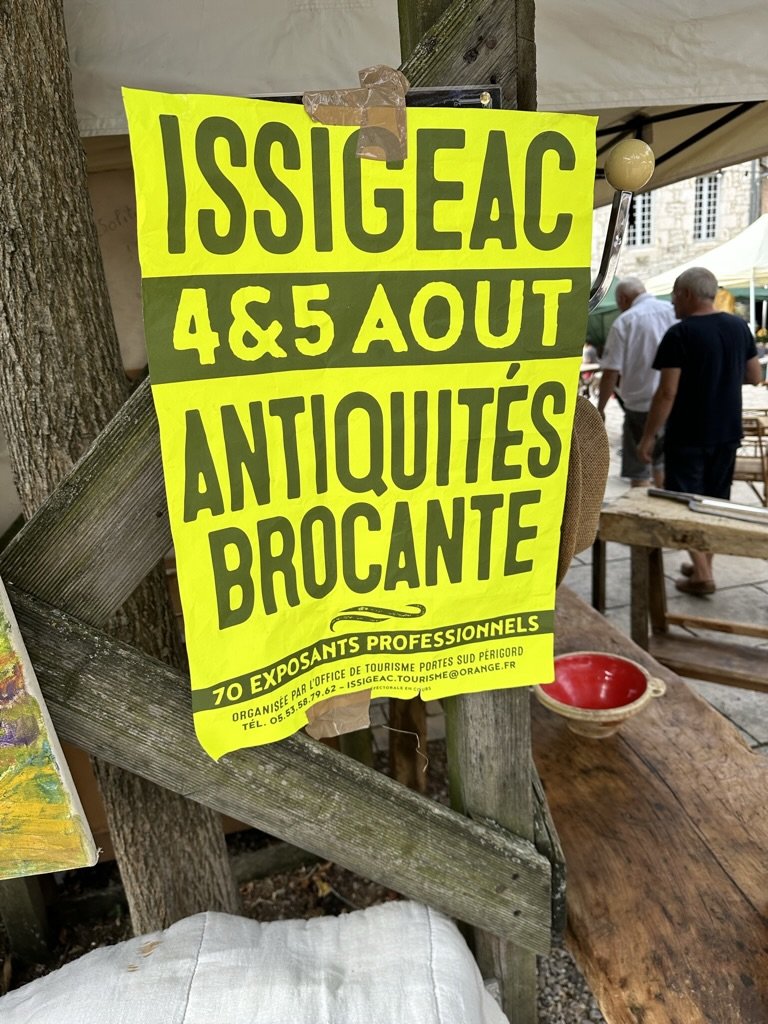
When Pat and Geoff are in England, we hunt the southern fairs ourselves with what they've taught us. Issigeac on Sunday — six minutes from the gate — has an antique and vintage strand running through its general food and produce stalls. Not a dedicated brocante day, but enough pieces turn up that we've bought more than a few small things there over the years. Chair frames, old linen, copper pans that weigh more than any modern equivalent. Issigeac also runs a dedicated antiques weekend in early August — *4 et 5 août, 70 exposants professionnels*, the posters announce — and that one is worth timing a trip around.
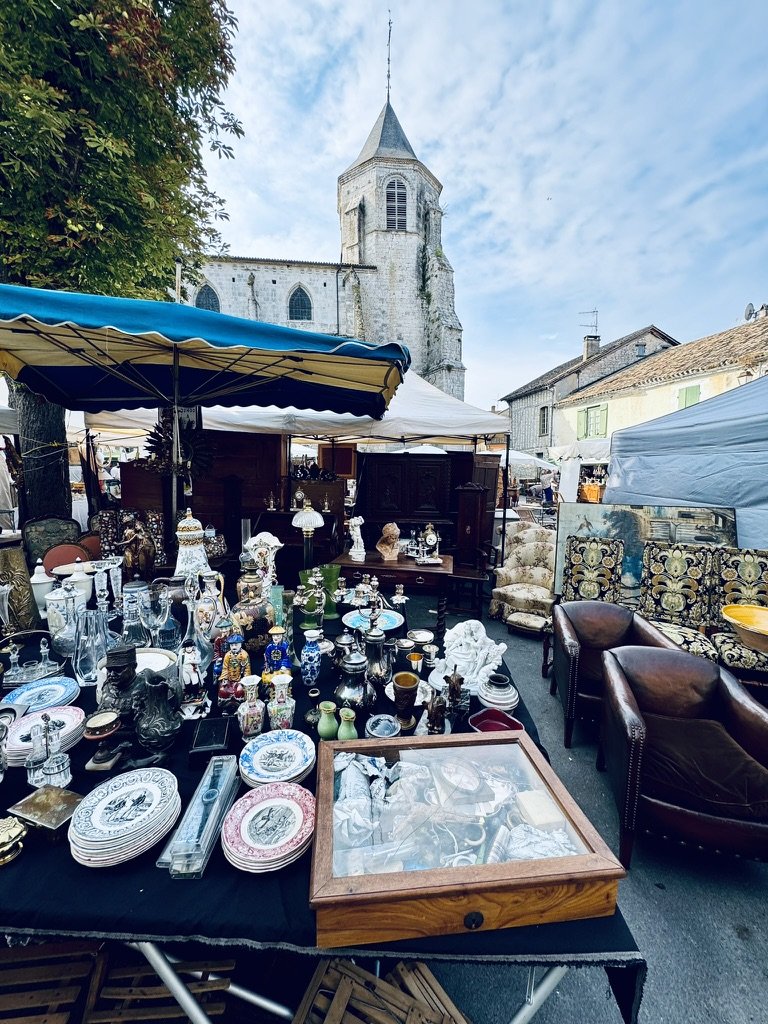
Beaumont-du-Périgord runs a dedicated antique market on Wednesdays. It's not enormous but it's curated — the dealers who set up there are serious about what they bring. Sarlat's weekend markets include proper antique dealers among the general stalls, and the town hosts dedicated brocante fairs several times a year.
VIII · Getting it homeStorage, shipping, and patience.
Pat and Geoff have a van. We have a car and a barn. The two are connected.
If you find something too large to carry home in a rental car, we have secure barn space at the estate where pieces can stay through the rest of your trip — and longer if needed. No charge. It's the kind of thing we do because we'd want the same when we're buying. If you're hunting seriously across a week, this changes what you can buy. A farmhouse table is no longer impossible; it's a logistics problem with a known solution.
For the actual shipping, we've worked with a couple of local freight forwarders in Bergerac who handle European routes — Scandinavia, UK, Netherlands — professionally and at reasonable rates. A large piece like a dining table might cost €300–€600 to ship to Copenhagen or Stockholm. Not nothing, but meaningfully less than the equivalent piece would cost you to buy at a Scandinavian antique dealer. If you buy several things across a week, we can help consolidate them into a single shipment, which is cheaper per-piece than shipping separately.
Pat and Geoff's van does the UK route directly. We have, on more than one occasion, sent things home with them when their trip back to England happened to coincide with a piece we'd bought. The trade has its own logistics. If you're a UK guest and you want a quote on shipping a specific piece, ask us — we may be able to put you in touch.
IX · A note on the relationshipWhat you're actually buying into.
One last thing, because it's the part of the article that wasn't really an article until I started writing it.
What Pat and Geoff have given us, over the years, isn't a set of rules for buying brocante. It's a relationship with the *trade* — with how things move, who knows what, where the inventory comes from, why a particular piece ends up at a particular fair on a particular Sunday. That's not knowledge that fits in a guidebook because it isn't really knowledge in the static sense. It's a *posture toward objects*. It's the willingness to walk past forty pieces to find the one that matters. It's the patience to talk to a dealer for twenty minutes about provenance before mentioning price. It's reading the face. It's knowing when the cash leaves your pocket.
The estate has filled itself with what that posture produces. Most of what you'll see when you stay with us — the screens in the bedrooms, the tables in the courtyards, the mirrors in the corridors, the linen on the beds — came through this kind of hunting, often with Pat or Geoff at our shoulder, often after a walk-past on the first pass and a return on the second. None of it is rare. Almost all of it is honest. The whole house, in a real sense, is a record of what they've quietly taught us to see.
Pat and Geoff are at Le Bost from roughly April through October. If you're staying with us in those months and you'd like an introduction — to them, to the northern fairs, to the rhythm of how a serious week of hunting actually works — ask. They are, properly, the most generous teachers we know.
Their Instagram is @lebostbrocante. The Etsy is in their bio.