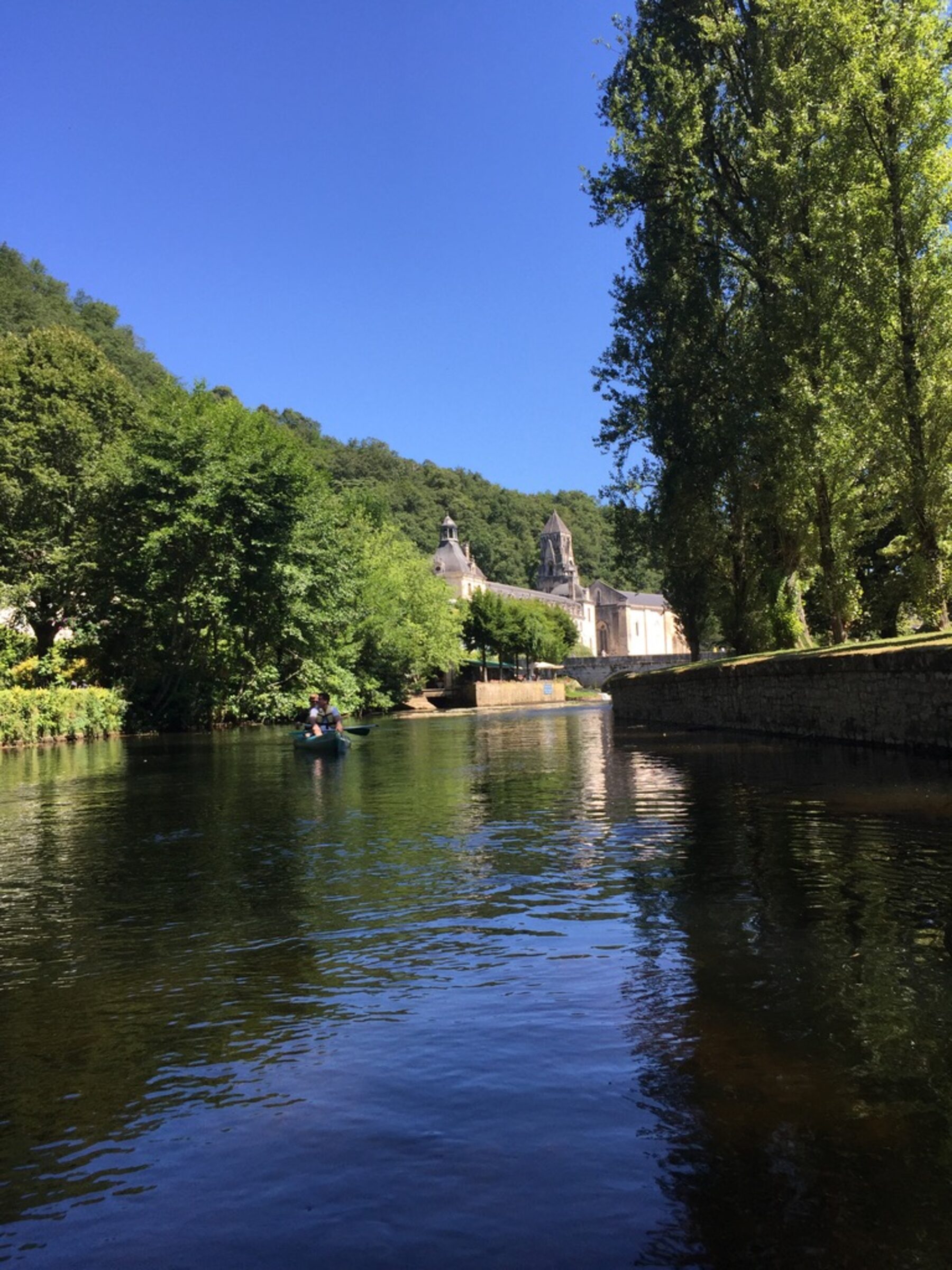
Some days out here are the big-set-piece days — Sarlat, the great clifftop châteaux, the painted caves at Lascaux. Those are the days you plan for the guidebook. This is the other kind. A day on the quiet roads, north from the estate through the Pécharmant vineyards, up through the market town of Saint-Astier, along the Dronne valley to Brantôme, and on into Périgueux for dinner. It's a loop, roughly — you leave south and come back south, with the whole of the middle Périgord turning in between.
It's also the day we send first-time guests on when they've already done the famous bits and want to know what we actually do. The quiet roads are the answer.
Leave at nine. Take cash for the market, an appetite for the park, and a jacket for the cathedral after dark. You'll be home by midnight. You'll also — if our experience with guests is a reliable guide — spend the rest of the week talking about it.
I · The startChâteau de Corbiac, a sign in a hayfield.
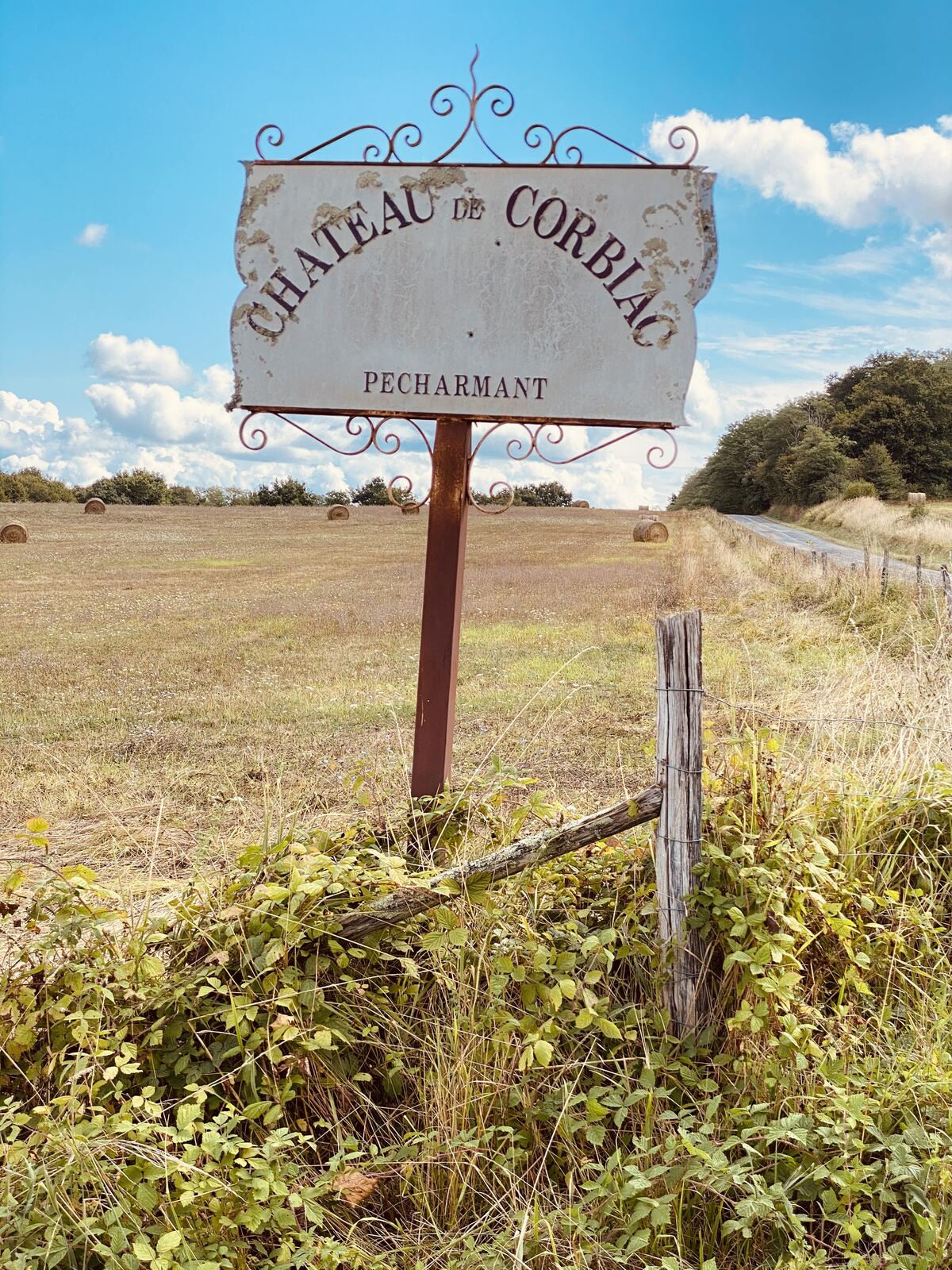
Thirty minutes north of the gate, the Bergerac vineyards give way to the higher ground of Pécharmant — the sub-appellation that produces the region's most distinctive reds. This is where we start the day. Not for a formal tasting — that's a different kind of day — but to buy a bottle of Château Corbiac for later. The bottle for dinner, in the shadow of the cathedral, when the sun has gone and the day needs something to drink.
Corbiac has been in the same family — the Monségurs — for more than five hundred years. The wines are unhurried, structured, age-worthy. Pécharmant is the Bergerac that doesn't try to be Bordeaux; it does something else, darker and more grounded, and Corbiac is one of the two or three houses that does it best.
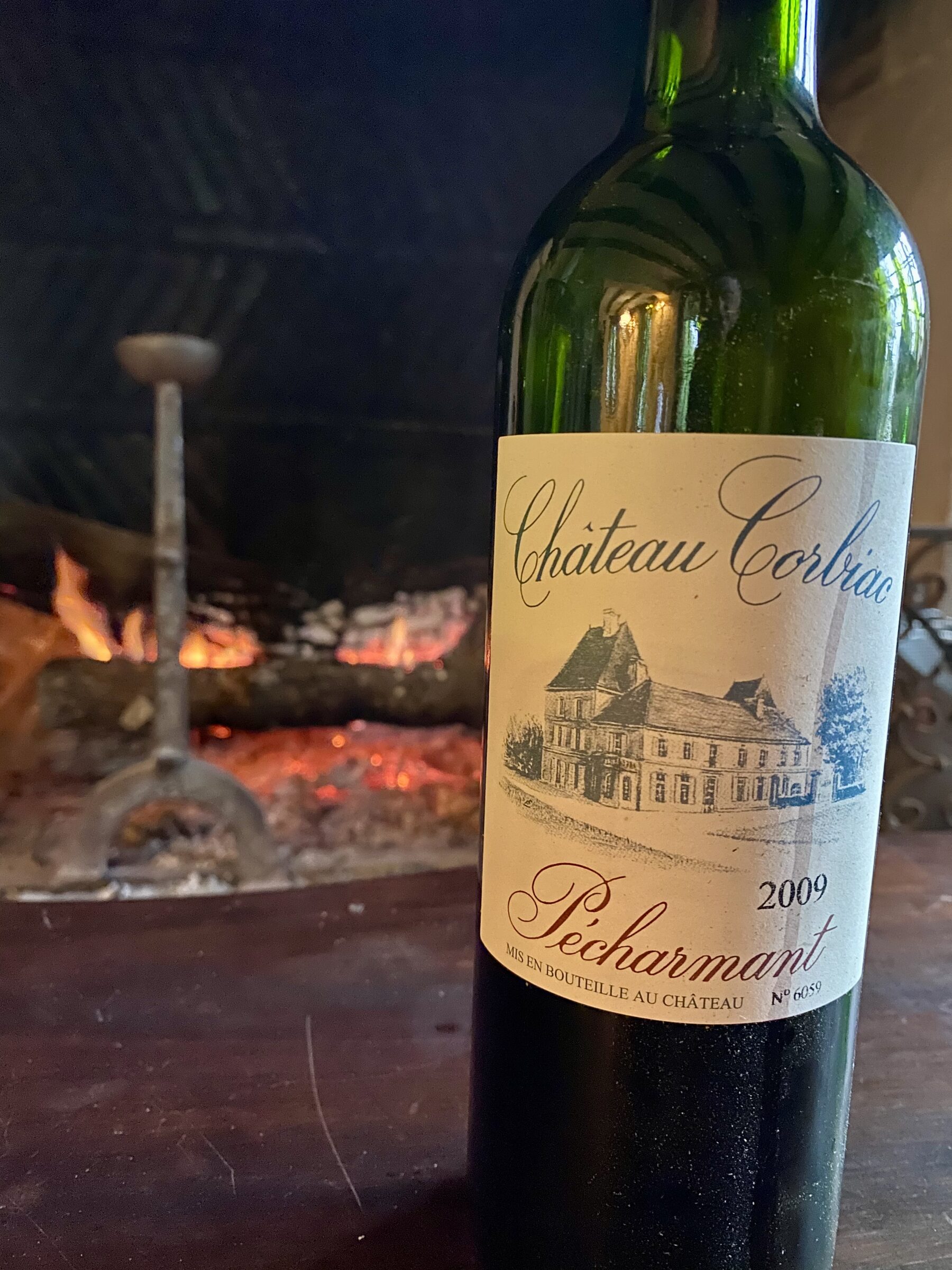
The road in is the quiet one — signs for Pécharmant, a turn off the D21, a hayfield with a hand-painted iron sign that doesn't make any great fuss about what's down the track. That sign is the clue that this isn't a tourist winery. It's a working château. Ring the bell, buy a bottle, talk about the vintage for ten minutes if you feel like it, and get back on the road.
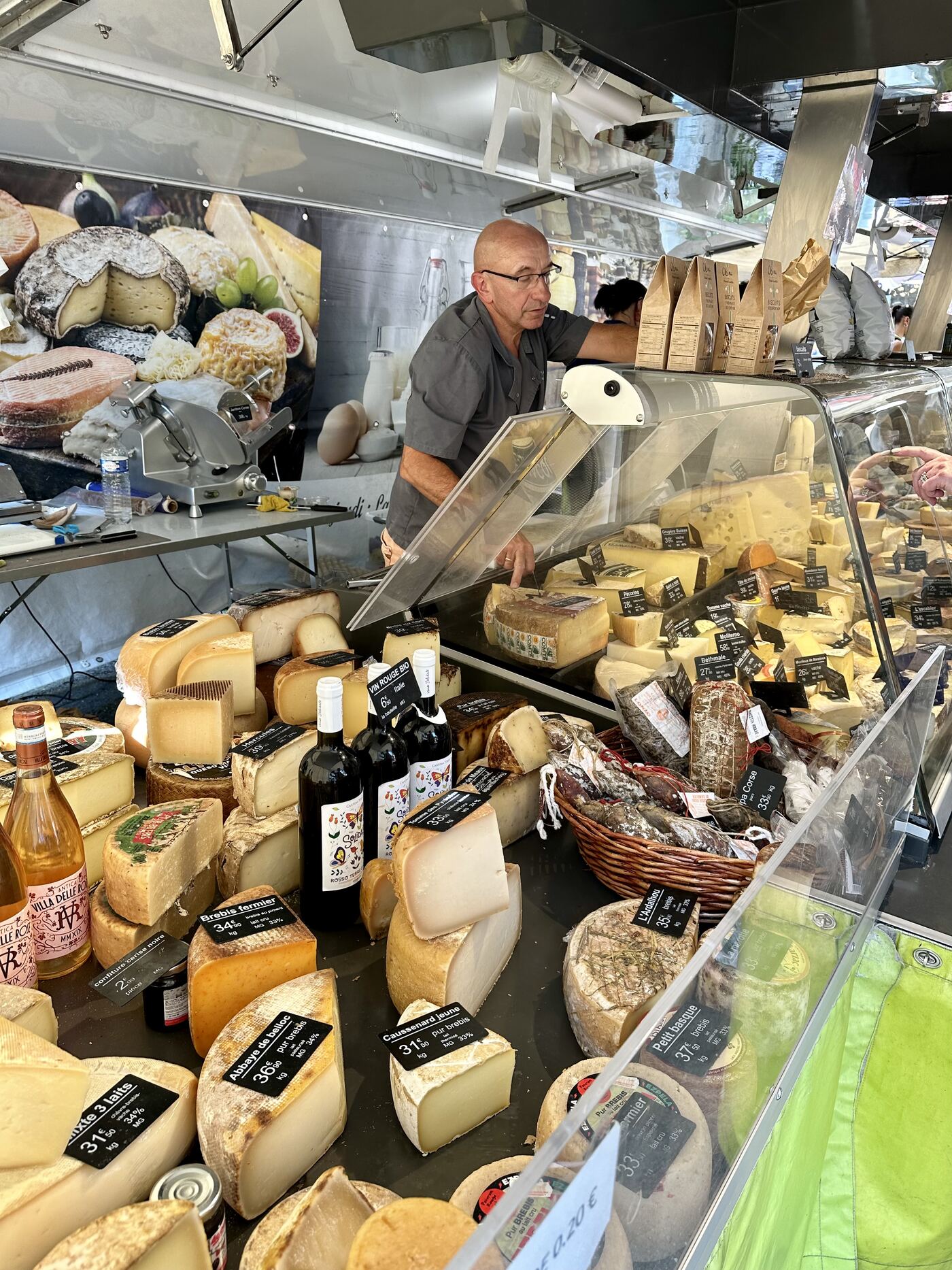
Saint-Astier on a Thursday.
Forty minutes further northwest, on the Isle river, is Saint-Astier. A market town of about five thousand, not pretty in the way Sarlat is pretty, but working — an actual town that keeps going when the tourists aren't there. The market is Thursday morning. That's the reason we come on a Thursday and nothing else.
What we buy, roughly: a good country bread from one of the two bakers' vans; a wedge of cantal or tomme from the fromager; a couscous salad with dried apricots and toasted almonds from the traiteur on the corner (they also do a roast quail that's excellent, cold); sometimes a slice of quiche if the queue is short. This is lunch. Not eaten here.
The trick at Saint-Astier is not to eat there. Buy the bread, buy the cheese, buy the quail, buy the coffee. Then get in the car.
A quick coffee at one of the cafés on the square — a café allongé, standing up, because the rest of the day is ahead and lunch is in the back of the car — and you're off.
III · The river roadThe Dronne valley, slowly.
This is the middle of the day and also, honestly, the point of it. From Saint-Astier, pick up the D-roads east and north, and drop down into the Dronne valley. The river is narrower and quieter than the Dordogne, cut through limestone, fringed with forest. The road follows it, mostly, through a string of villages most people have never heard of.
We pass Tocane-Saint-Apre, a lovely old market town with a Romanesque church and a stone bridge over the Dronne. Family of ours has a 16th-century house there — the kind of detail that tells you something about how this region works: old houses haven't been sold off or converted, they've been kept in families, sometimes for centuries. You pass a dozen of them on this drive and never know.
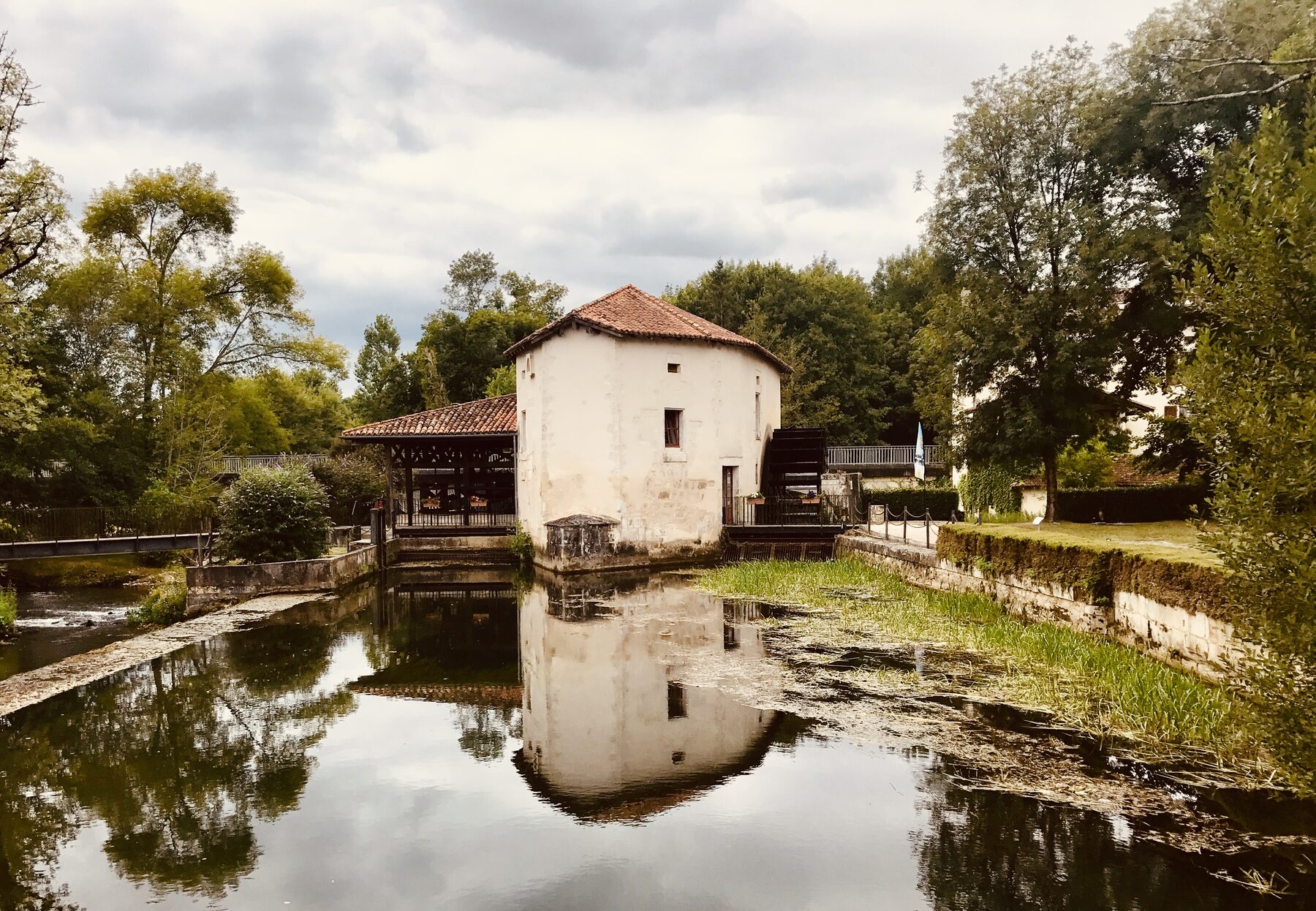
Somewhere between Tocane and Bourdeilles, pull over. There's a hand-painted sign off the D-road pointing down a track through the trees. At the end of the track is a water mill — a white-plastered stone building, its wheel on the far side, a covered lavoir (the old communal washhouse) tucked up alongside it, and the whole thing sitting in a mirror of still water where the Dronne widens into a mill pool. Walk down, stand at the edge, look for the reflection. Five minutes of nothing particular: the stillness of the pool, the creak of the wheel, the forest closing over the road above you. This is why you take the quiet road and not the A89.
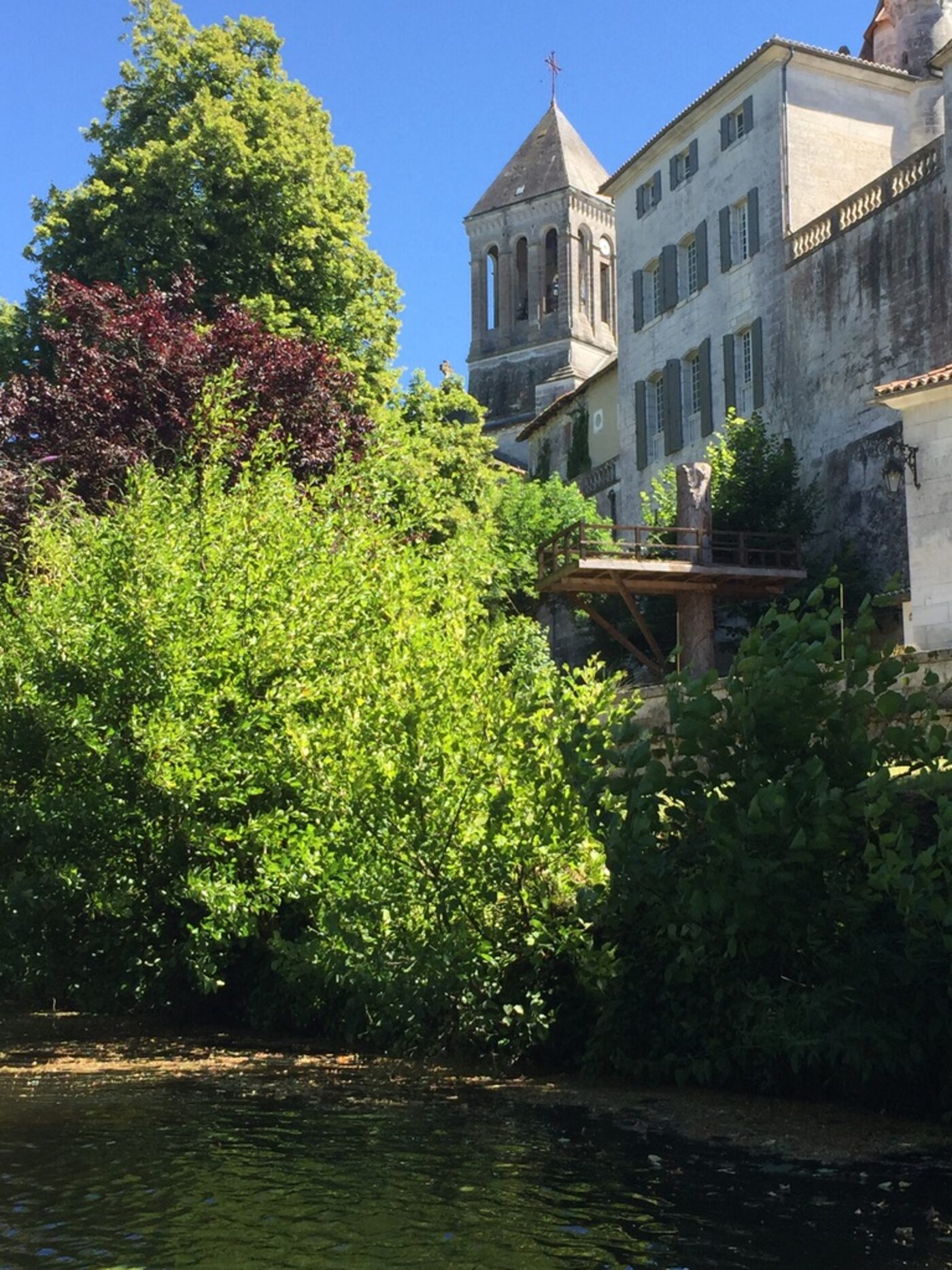
Bourdeilles itself is worth slowing down for. A 13th-century château sitting on a rock above the river, a medieval bridge that looks staged for a film set, a village that has somehow managed not to turn itself into a tourist shop. You can stop here if you have time. We usually don't — the park at Brantôme is calling — but we always slow enough to look up.
IV · The lunchBrantôme, in the park.
Stephanie calls Brantôme the prettiest town in the Dordogne, and I haven't found an argument against it yet. It's called the Venise du Périgord because the old town sits on an island wrapped by a loop of the Dronne, and it's on every list of France's plus beaux villages, and yes all of that sounds like the kind of tourism-board writing that normally puts us off. Go anyway.
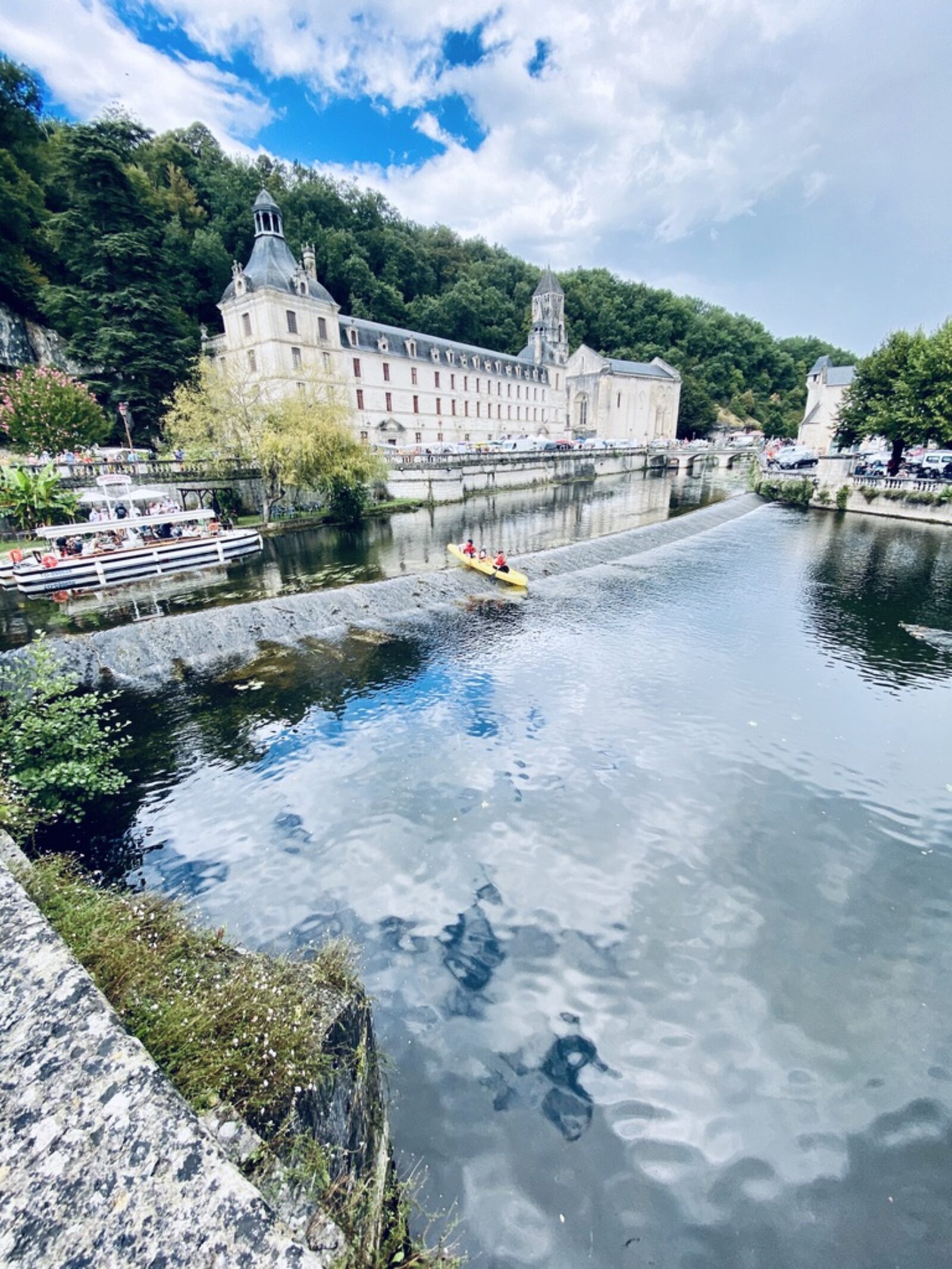
Park on the edge, walk in over one of the bridges. The abbey is 8th-century at its core — founded by Charlemagne, according to the stories — and it's worth a look, but the actual move is to keep walking through the old town to the Jardin des Moines, the riverside park where the monks used to take the air. There are two enormous sequoias there, planted in the 19th century and now roughly the height of a small cathedral, and underneath them is where you eat lunch.
Spread the market out on a bench or on the grass. Break the bread with your hands. The cheese, the couscous, the quail, the quiche. A bottle of something light, Bergerac rosé works, if you thought ahead in Saint-Astier. The sequoias do the rest.
Two enormous sequoias, planted in the 19th century, now roughly the height of a small cathedral. Underneath them is where you eat lunch.
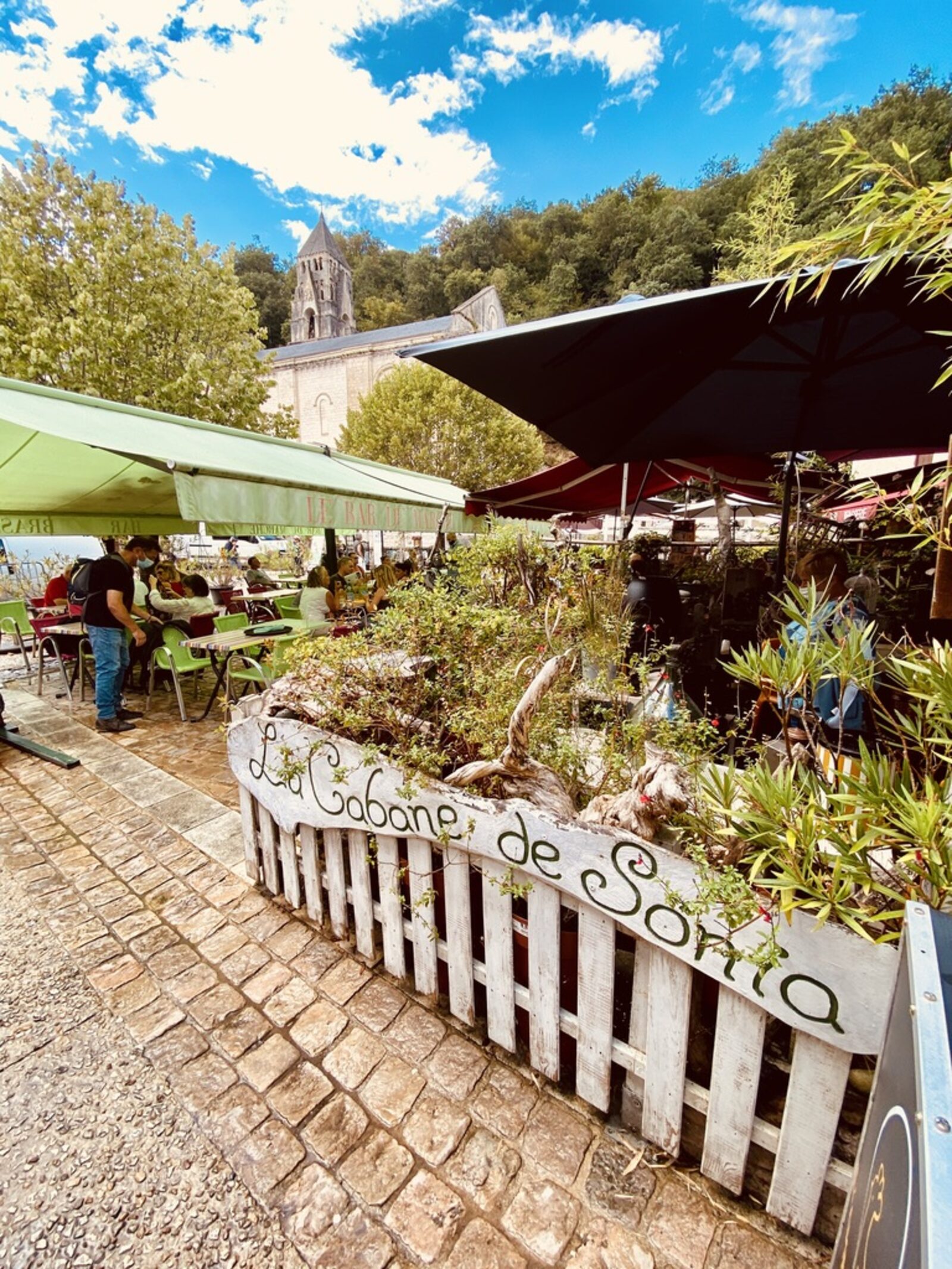
After lunch: the abbey if you haven't seen it, an hour wandering the old-town streets, an ice cream from one of the glaciers on the main shopping street. The ice cream is not negotiable. Get two scoops. Walk back to the car the long way, along the river.
V · The eveningPérigueux, in the shadow of Saint-Front.
From Brantôme to Périgueux is half an hour south on the D939. You arrive into a city in the late afternoon, and it's the kind of city people don't expect: bigger than Sarlat, not famous in the way Sarlat is famous, but with a genuine old town, a genuinely magnificent cathedral, and the feel of a place people live in rather than visit.
The Saint-Front cathedral is the reason you come. Five domes in the Romano-Byzantine style, more Istanbul than France, heavily restored in the 19th century (the architect was the same man who restored the Sacré-Cœur, which explains a lot), but genuinely astonishing to arrive at on foot from the medieval streets below. You round a corner, and there are the domes.
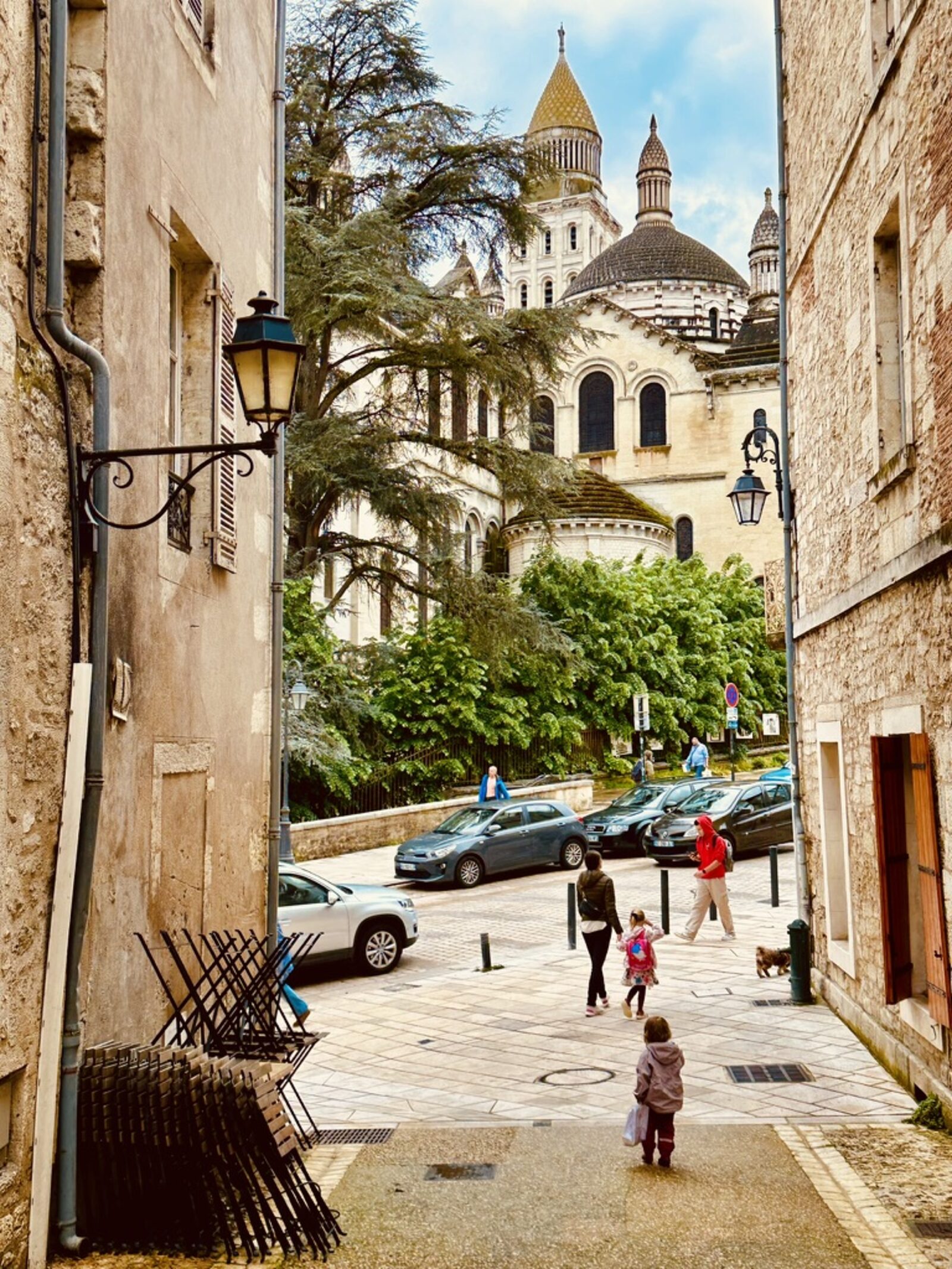
Walk the old town for an hour before dinner. The Quartier Saint-Front is all cobbled streets and half-timbered houses and small shops selling things you didn't know you wanted. On a good evening the light is on the stone and the cathedral is lit and you've walked thirty thousand steps and it's all fine.
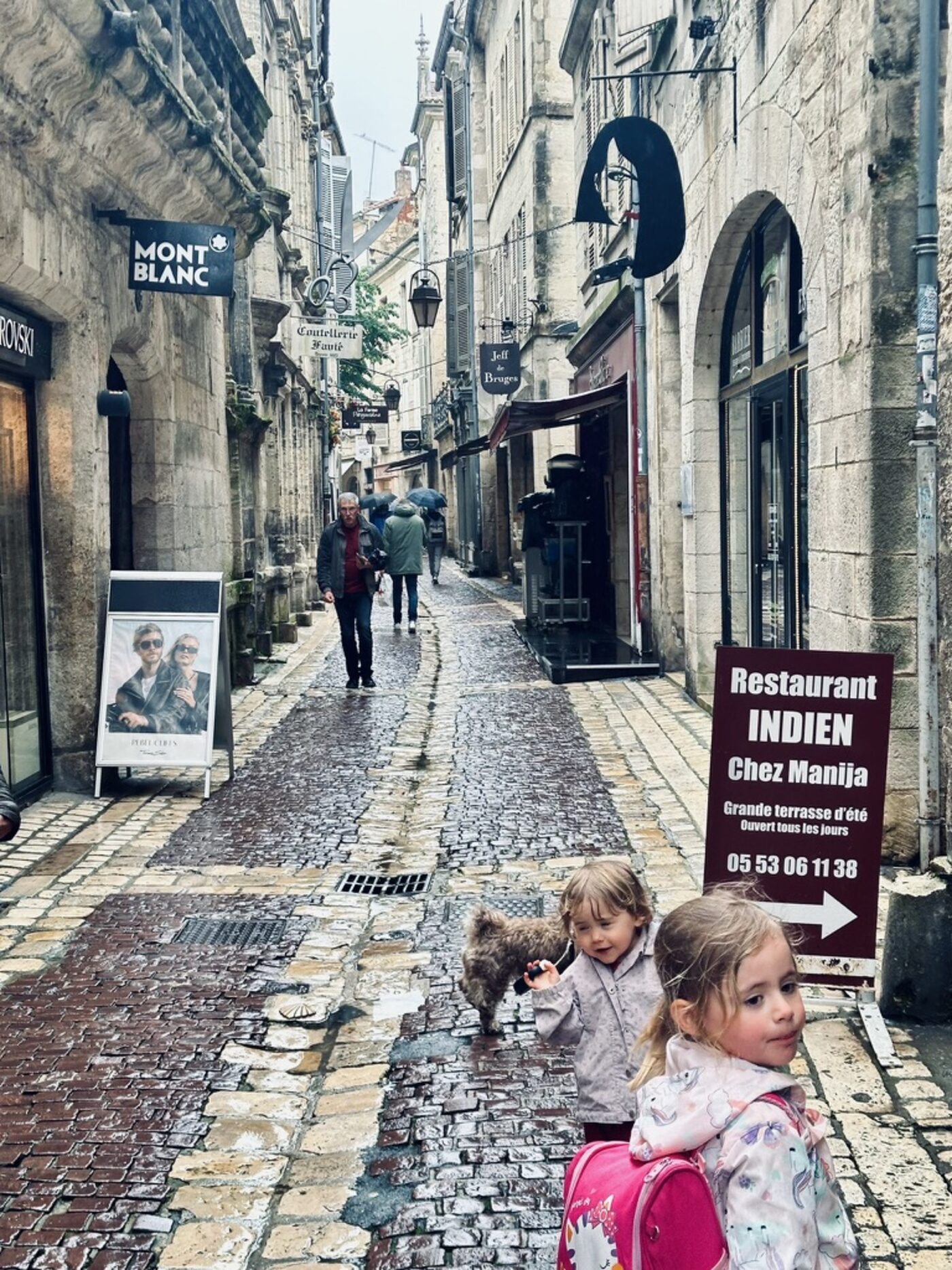
Our dinner stop in Périgueux is, honestly, a back-street Indian. Fifty metres from Saint-Front. It's called Chez Manija, and it's been there for years. We're aware that after a day driving through Pécharmant vineyards, buying French market cheese, lunching under 19th-century sequoias, and walking up to a cathedral on UNESCO's World Heritage list, ending the evening with a saag paneer is faintly ridiculous.
We do it anyway. The food is good, the room is friendly, the cathedral is still there at the end of dinner. If you'd rather eat French — and there are perfectly good places on Place Saint-Louis — that's fine too. But we're not writing a guidebook.
Open the Corbiac when you get home. The day is long; it wants an ending.
Morning — out
- 09:00 leave the estate
- 09:30 Corbiac — buy a bottle of Pécharmant
- 10:30 Saint-Astier — Thursday market, coffee, shop
- 12:00 Dronne valley road — stop at the water mill
Afternoon & evening — back
- 13:00 Brantôme — picnic in the Jardin des Moines
- 15:00 Abbey, old town, ice cream
- 17:30 Drive to Périgueux, walk the quartier
- 19:30 Dinner near Saint-Front
- 23:30 Home, open the Corbiac
If you've done this day, we'd love to hear what you skipped and what you added. Our Marqueyssac day is the other direction — east rather than north — and makes a good companion for a Thursday two weeks apart.