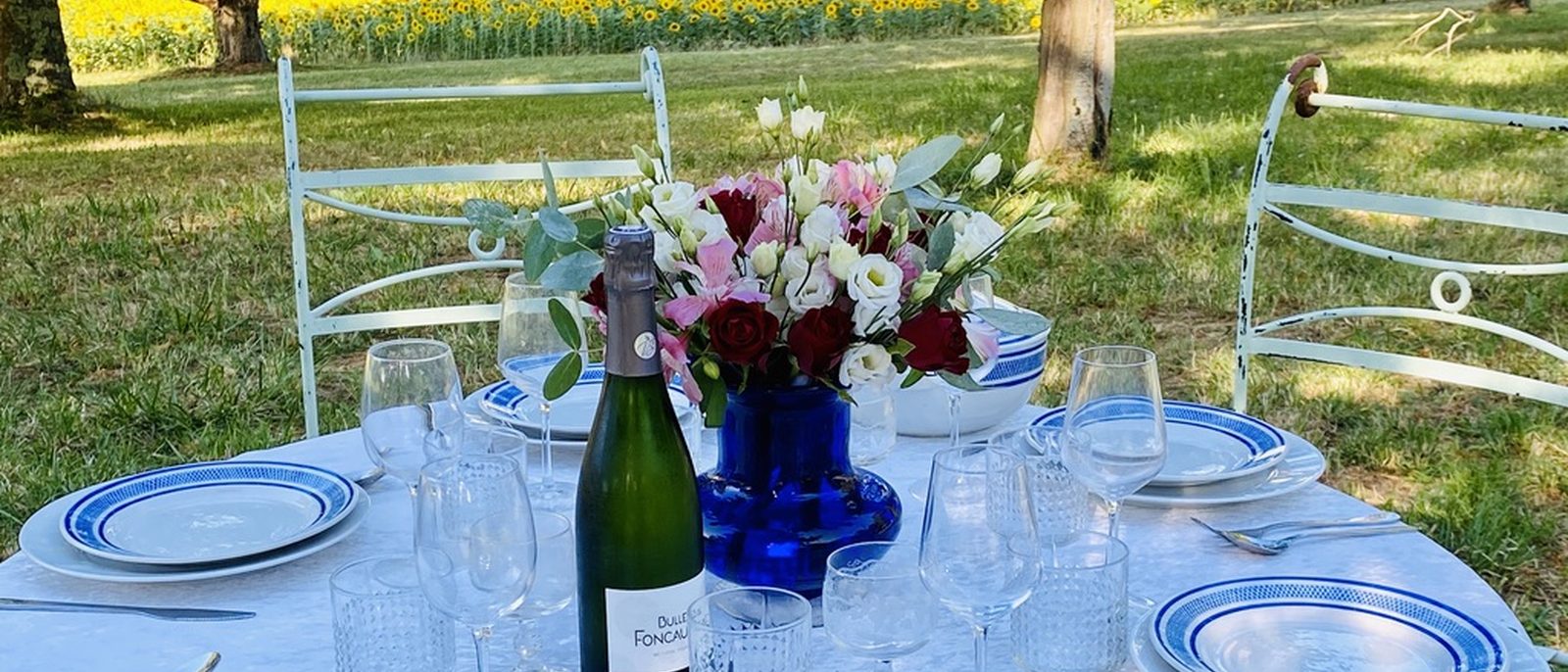
The first thing worth saying about pairing is that most things work. Especially with foie gras — it's the great equaliser of the French table, and almost any wine with a bit of structure or a bit of sweetness will carry it. The orthodoxy says Sauternes or Monbazillac with foie gras and the orthodoxy is correct, but it's also correct that a chilled red, an off-dry Riesling, an oaked Chardonnay, even a properly cold rosé all carry it perfectly well. Most things work.
What follows isn't a pairing chart. It's one long evening at the estate, in roughly the order it tends to unfold, with the wines we actually pour and a short note on why. The article assumes you've read the cellar list, but it doesn't repeat it. Some of the bottles below are local. Some aren't. The dish leads, not the course category, and the wine follows. That's the whole rule.
I · The apéritif hourBubbles, before everything.
The evening usually starts with bubbles, and at the estate we pour one of two. The everyday choice is the Pét-Nat from Tour des Gendres, a few villages west — cloudy, alive, slightly unpredictable, made by ancestral method from Sauvignon Blanc. It's the kind of bottle that doesn't settle the table; it wakes it up. We pour it when the guests look like they're going to be interesting.
The catch, and the reason this isn't a recommendation a restaurant guide can make: the Tour des Gendres Pét-Nat sells out before summer most years. They're a small, properly biodynamic family estate making limited wine, and the Pét-Nat goes through the cellar before the AOC bottles. If you want to drink it, you pick it up at the cellar door early — May, June at the latest — or you ask us if we have any in our own cellar.
The wine to pour when the Tour des Gendres has run out, or when the evening is more relaxed, is the sparkling rosé from Château de la Jaubertie. Made by the traditional method, dry, no ceremony. Properly distributed, so you'll find it on most local restaurant lists — which is the first instance of a pattern this article keeps returning to: Jaubertie is the producer that's reliably there when you eat out around here. More on that further down.
If the meal is more ceremonial — anniversary, the first night of a long stay, anything that calls for a bit of theatre — the bubbles shift. We mostly drink Crémant de Bourgogne at the estate, and the bottle that earns its place in our cellar is the Vitteaut-Alberti Cuvée Soie from Rully, in the Côte Chalonnaise. Vitteaut-Alberti has been making Crémant in the same village since 1951, three generations, now run by Agnès Vitteaut, and Rully itself has been producing sparkling Burgundy since 1822 — so this isn't an upstart category trying to get noticed. It's the historic cradle of Crémant de Bourgogne. Same Chardonnay and Pinot Noir as Champagne, same chalk-and-limestone soil, same traditional method, ageing on lees the same way — and roughly a third of the price. A bottle of the Cuvée Soie is €15-22; the equivalent grower-Champagne is €40-60. We pour Champagne when the occasion is properly ceremonial. The Cuvée Soie the rest of the time, which is most of the time.
II · The opening whiteL'Ancienne Cure, and the Muscadelle finish.
The first proper course — usually a salad, a chilled soup, something with goat's cheese, occasionally a terrine — gets a Bergerac Blanc, and almost always one from Domaine de l'Ancienne Cure. Christian Roche is the fifth generation on the estate, biodynamic-certified since 2012, and his whites are the cleanest expression we know of the classic Bergerac white blend: Sauvignon Blanc for citrus and bracing acidity, Sémillon for body, and Muscadelle as the third grape, the one that's easy to miss and does the most for the character of the wine.
The Muscadelle is the part to pay attention to. It brings a slightly peppery, floral note on the finish — a small spice on the back of the palate that the Sauvignon-Sémillon pair on its own doesn't give you. The producers around here who lean confidently into the Muscadelle — Ancienne Cure, Les Verdots, Tour des Gendres — are the ones whose whites we keep coming back to. The wine doesn't dominate the food. It opens the palate. It's also good on its own, an hour before the meal, if the apéritif goes long.
III · Oysters, scallops, and the Rully threadBubbles for one, still for the other.
Oysters want salinity, acidity, and bubbles, and most travel writing reaches for Champagne and stops there. That's correct in principle and lazy in practice. The honest answer is that the best Crémants — the traditional-method sparkling wines from outside Champagne — match good Champagne for a fraction of the price, and the Vitteaut-Alberti Cuvée Soie from Rully that opens our evenings is properly mineral and saline in a way that earns the slot rather than just substituting for it. The Pinot Noir-led blend gives the wine body; the chalk-and-limestone soil of the Côte Chalonnaise gives it a saline cut on the finish that resonates with the oyster directly. The same fundamental geology runs north through Chablis and into Champagne itself — different appellations, same rock, same mineral signature. The Cuvée Soie isn't a substitute for Champagne with oysters. For most evenings, it's the better choice.
If scallops follow the oysters — seared, with butter, the classic French preparation — the wine stays Burgundian but moves to still. The same village. Rully Chardonnay from the Côte Chalonnaise: the producer's value sweet spot in white Burgundy. A village-level Rully is €25-30 a bottle; the equivalent quality from a famous postcode is three to five times that. The wine has the body for butter without the ceremony. We pour it when we want white Burgundy without the price.
The reader who's paying attention will notice the same village twice in one chapter. That's deliberate. We've decided Rully is the postcode we trust, and we pour from it for both the bubbles and the stillness on the same evening. The chapter is a small case study in how a household lands on a producer or a region after enough drinking to know — and then sticks to it.
IV · Shellfish, fish, and the Chenin questionSalinity matters. Sometimes.
If the next course is fish — sea bass, brill, salmon, anything baked or grilled with butter — the Bergerac whites continue to work fine. L'Ancienne Cure carries a meal of fish through several courses without any drama, and that's the right answer most of the time.
The interesting case is shellfish that isn't oysters or scallops — anything sharper or more saline. There's a Jaubertie Chenin made twenty minutes from the gate. Interesting wine, organic, the producer who first put Chardonnay in Bergerac trying the same trick with Chenin. We respect the wine on its own terms, and we'll write more about why it matters in another piece. But on the table with shellfish, we pour a Loire Chenin from our own cellar instead. The flint and tuffeau soils of the Loire give the grape a saline cut the Bergerac soil doesn't have. The grape adapts; the soil doesn't lie.
V · Beef, pork, lambThe middle of the meal, three ways.
Beef — Bergerac Merlot, in almost any form. Most of the under-€15 Bergerac reds at the weekly markets are Merlot or Merlot-led, and most of them are pleasant with a roast or a steak. Don't overthink it. The Merlot wins because it's soft enough to handle simple cooking and it doesn't try to be more important than the food.
Pork — Jaubertie's Mirabelle Rouge. The mid-tier Bergerac red, 45% Cabernet Sauvignon, 45% Merlot, 10% Cabernet Franc, eighteen months in French oak. Around €20-25 at the cellar door. The Cabernet structure handles the richness of pork — particularly anything slow-cooked, anything with apples or cider, anything from the Périgord noir tradition — and the Merlot keeps the wine from being stiff. It's also the bottle that's reliably on local restaurant lists, which means you can order it confidently when you eat out without having to brief us first.
Lamb — Cahors Malbec, or a Saint-Émilion if the occasion is special. Cahors is forty-five minutes south-east; the wine is dark and tannic and built for the same kind of richness lamb brings to a table. Saint-Émilion is the upgrade — the Right Bank Bordeaux that handles lamb with more finesse and more cost. We pour Cahors most weeks. Saint-Émilion when we're being careful about an evening.
VI · Duck, the Périgord questionThe orthodoxy is right.
Duck deserves its own chapter, because this is the Périgord and you'll eat magret or confit at almost every restaurant within an hour of the gate, often more than once a week. The orthodox local pairing is Cahors Malbec, and the orthodoxy is correct. The wine's iron-rich, dark tannins cut through duck fat better than almost anything else in France, and the regional history of pairing the two together goes back centuries. There's no point being contrarian about it.
The upgrade, again, is Saint-Émilion — particularly with magret de canard rather than confit. The meat is leaner, the wine can be a little more refined, and a good Saint-Émilion makes the dish feel ceremonial in a way the Cahors won't quite. For confit, with its richer fat and longer-cooked depth, the Cahors is honestly better. The wine and the dish were built for each other.
If you don't want red — which sometimes happens, especially with confit at lunch in summer — a properly cold Monbazillac works with foie gras and can carry across to the duck course if you're brave. It's unorthodox and it's lovely, and it's the kind of thing the orthodoxy gets wrong.
VII · Home versus restaurantDistribution, not price.
This is the chapter that explains why some of the wines mentioned above keep appearing and others don't. The home-versus-restaurant split isn't really about price. It's about distribution.
Château de Corbiac in Pécharmant — the iron-rich north-east corner of the appellation — is one of the historic family estates of the region, owned by the Durou family since 1587. They make a properly serious Pécharmant red: 60% Merlot, 15% Cabernet Franc, 15% Cabernet Sauvignon, 10% Malbec. Dark, structured, ages well, drinks well now. It's our house red when the group is big enough to need a case. But Corbiac is small. They sell most of their wine direct from the property and to a handful of regional cellars. Unless a restaurant has a personal relationship with the family, they don't carry it. So you drink Corbiac at the estate, or you drink it at the property itself. You don't drink it out.
Jaubertie is the opposite case. The Ryman family runs a properly organised 50-hectare estate, organic since 2008, with proper distribution across the region and small export volumes beyond it. Every decent restaurant within forty minutes of the gate has at least one Jaubertie wine on the list, and the Mirabelle Rouge is the one that's reliably there at a price that doesn't insult you. It's also genuinely good. When we eat out locally, that's what we order. The Mirabelle Rouge has done more for the everyday Bergerac dining experience than any other single bottle.
The same logic runs through the apéritif hour. Tour des Gendres Pét-Nat sells out at the cellar before summer because they're small and don't distribute widely. Jaubertie's sparkling rosé is the apéritif you can actually find on a restaurant or wine-bar list, because Jaubertie distributes properly. So if you remember one producer when reading menus locally, it's Jaubertie. If you remember two, the second is Tour des Gendres for the Pét-Nat at the cellar door.
VIII · The closingMonbazillac, and a 1995 if you're staying with us.
Dessert, at the estate, is almost always Monbazillac. Roquefort is the obvious cheese pairing; Bleu d'Auvergne or Fourme d'Ambert work just as well. The wine's honey-and-apricot weight balances the salt of the cheese in a way that most red wines don't quite manage. It's the better pairing, even if the book says otherwise.
Walnuts — properly fresh walnuts, ideally from the Périgord, ideally cracked at the table — also work surprisingly well. The bitterness of the nut against the sweetness of the wine is one of those pairings that sounds wrong on paper and lands cleanly in the glass. Vanilla ice cream is the easy crowd-pleaser, particularly with a slightly older Monbazillac where the wine has shifted from primary fruit toward caramel and dried apricot.
And if you're staying with us — and the evening has gone properly long, and the cheese has come out, and the candles are still burning — there's a 1995 Monbazillac in the cellar. The 1995 vintage was an exceptional year for botrytised wines: warm dry autumn, perfect noble rot conditions, the kind of vintage producers still talk about. The bottle has been waiting thirty years for a good evening. We open it for guests we like.
IX · One honest noteWhat doesn't work, and why.
One thing worth saying that most pairing guides won't. The Bergerac makes Cabernet Sauvignon, and most of it under €20 is too tannic — the grape's tannins don't fully resolve on the heavy clay soils of this corner of the appellation. Ageing helps; oak helps; price reflects both. Jaubertie's Cuvée Colombier at €60-plus is the local example of Cab Sauv done properly here, and it's worth what it costs. Below €20, the Merlots and the Mirabelle Rouge are reliably better choices. Don't be tempted by the cheap Cab Sauv, even though it's everywhere in the markets. We've written about why the terroir works against it in another piece.
The other thing worth saying, briefly: the lazy reflex of "a big Bordeaux with the steak" is wrong here. A €40 Bordeaux is a worse pairing for most beef dishes than a €12 Bergerac Merlot. The big-Bordeaux move makes sense in a city restaurant where the prestige is part of the meal. At a long lunch in the country, with food cooked simply and friends who'd rather talk than be impressed, the Merlot wins every time.
Pairing isn't intricate. The dish leads. The producers around here aren't trying to win at French cuisine. And most things — really, most things — work.